
18 June 2003
American Forces Capture Top Aide to Saddam Hussein
American Forces Capture Top Aide to Saddam Hussein
By DAVID STOUT and ERIC SCHMITT
http://www.nytimes.com/2003/06/18/international/worldspecial/18CND-CAPT.html
WASHINGTON, June 18 — Saddam Hussein's senior bodyguard, one of the few people the former Iraqi leader trusted completely and a witness of potentially enormous importance, has been captured in Iraq, American military officials said today.
The bodyguard, Gen. Abid Hamid Mahmud al-Tikriti, ranked as the No. 4 most-wanted Iraqi and dubbed the "ace of diamonds" in the American military's playing card-style "top 55 list," was captured on Monday, the United States Central Command said.
The announcement by Central Command, which has overall charge of the military campaign in Iraq, gave no details of the capture. Nor did it say whether General Mahmud, whose official title was presidential secretary, was cooperating with interrogators.
The military also announced that American forces raided two farmhouses near Tikrit today, seizing about 50 former members of Iraq's Special Security Forces and Special Republican Guard and a stash of cash and jewels that a senior Army commander said was being used, at least in part, to pay for bounties to kill American soldiers.
In the early-morning raids, the American troops seized more than $8.5 million in American dollars, jewels valued at more than $1 million, and large amounts of euros, British pounds sterling and Iraqi dinars, officials said. Troops later seized a vehicle leaving the scene that was carrying more than $800,000 in cash.
The announcements came on the same day that an American soldier was killed and another was wounded in a drive-by shooting in central Baghdad, the latest in a series of assaults on the United States military.
General Mahmud's capture comes at a crucial time, as the war in Iraq and postwar reconstruction emerge as hot political issues on Capitol Hill.
Deputy Defense Secretary Paul D. Wolfowitz and Gen. Peter Pace, vice chairman of the Joint Chiefs of Staff, are testifying today before the House Armed Services Committee on United States commitments in Iraq. And some Democratic lawmakers have continued to question whether the Bush administration made an adequate case for going to war, particularly in its citing of evidence that Iraq had weapons of mass destruction.
Some military and intelligence officials believe that if anyone knows the whereabouts of Saddam Hussein himself, and the whereabouts of any Iraqi chemical and biological weapons, it would be General Mahmud.
There have been no confirmed sightings of Mr. Hussein alive in many weeks. The American-led military tried at least twice to kill him by airstrikes during the Iraq invasion, and the rubble from those raids is still being sifted for evidence of his remains.
Although General Mahmud is No. 4 on the most-wanted list, he is thought to have been third in power in the Baghdad regime — behind only Mr. Hussein and his son Qusay.
One opinion of the general's stature was given by the onetime Iraqi exile leader Ahmad Chalabi, who recently reflected on the hunt for Saddam Hussein and whether he might be in hiding with his sons.
"He is not traveling with Uday or Qusay," Mr. Chalabi said. Rather, Mr. Chalabi surmised, the deposed dictator — if still alive — would be traveling with General Mahmud.
Steven Emerson, an expert on Middle East terrorism, offered another perspective on the general in an April 24 interview on MSNBC, shortly after the attempts to kill Mr. Hussein.
"This is a guy that really knew exactly where entire operational secrecy was for Saddam Hussein, where the palaces were, where the bunkers were, where his hideouts were, where exactly he would go in case there was an attack," Mr. Emerson said. "He was the No. 1 bodyguard, if you so will, even though he didn't like that title, and he would be responsible for tracking Saddam Hussein 24 hours a day. If he got any word that there was going to be an attack, he would wake him up 15 minutes before, oust him and bring him to someplace else."
If the general can indeed provide intelligence on the status of Iraqi weapons of mass destruction, or the lack of them, his words could have a huge impact in Washington, and perhaps on international opinion, since the Bush administration cited the presumed existence of such weapons as a central justification for going to war.
The chief White House spokesman, Ari Fleischer, termed the arrest of General Mahmud a "significant capture." But when a reporter asked him if it was "a potential boon in your so far fruitless hunt for weapons of mass destruction," Mr. Fleischer dismissed the term "fruitless" as "a throwaway line" and said that the hunt for weapons had been "a very careful search." and that mobile laboratories found in Iraq could have been used to make biological weapons.
General Mahmud, whose name has been rendered from the Arabic in several ways, is a distant cousin of Saddam Hussein. The name Tikriti comes from Tikrit, Saddam Hussein's hometown, near Baghdad. While Saddam Hussein was in power, he was a familiar, if somewhat bland, figure almost always seen standing to the rear of Mr. Hussein during the leader's orchestrated news appearances.
General Mahmud will probably face charges himself. United States officials have said they want to try him for war crimes or crimes against humanity for his activities within the Hussein leadership.
Discussing the seizure of money and gems today, the commander of the Fourth Infantry Division, Maj. Gen. Ray Odierno, told reporters at the Pentagon in a video conference from Baghdad that American forces continued to face resistance from former Baath Party loyalists, Islamic fundamentalists and "poor Iraqis" who are being paid bounties to kill American troops. "They're being paid by ex-Baath Party loyalists, who are paying people to kill Americans," he said.
But General Odierno repeatedly said that attacks on American forces in his sector, a swath of territory the size of West Virginia that stretches north of Baghdad to Kirkuk, and then east to the Iranian order, were uncoordinated strikes by groups of three to five fighters that he viewed as acts of increasing desperation.
In Baghdad today, a United States military spokesman said, attackers fired on soldiers from the First Armored Division from a passing vehicle, killing one soldier and injuring another. On Tuesday, a soldier from the same division died after being shot in the back by a sniper while on patrol in northern Baghdad.
Today's incident brings the number of American soldiers killed in Iraq since major combat was declared over on May 1 to at least 42. It is also the 12th fatal attack on the American military in the last three weeks.
The attack came after an American soldier fired into a crowd of protesters at the gates of a palace in Baghdad this morning, killing two Iraqis. Americans from the First Armored Division fired warning shots after the protesters threw rocks at a convoy trying to enter the palace.
The convoy passed through the crowd, made up of former Iraqi Army officers and soldiers protesting their lack of pay since coalition forces disbanded the army.
General Odierno said he was not surprised by the recent attacks on American forces — many of them deadly — especially as the armed sweeps have increased. "We're dealing with people who have everything to lose and nothing to gain," he said.
But the general asserted that it was an overstatement to call the resistance guerrilla attacks.
"It is not close to guerrilla warfare because it's not coordinated, it's not organized, and it's not led," he said. "The soldiers that are conducting these operations don't even have the willpower. We find that a majority of the time they'll fire a shot, and they'll drop the weapon and they'll give up right away. They do not have the will."
General Odierno said there were some foreign fighters Syrians and Iranians among the prisoners taken recently, but that his cavalry forces had effectively sealed the Iraqi border with Iran to keep out any fighters from infiltrating from there.
"We have shut the border down and there is a lot less individuals being able to come into Iraq," he said.
Storm King, Dia Beacon, and Donald Judd
this weekend, went with MOMAJA to visit the Storm King Art Center and Dia Beacon in Orange and Dutchess Counties, 50-60 miles north of the city.


Storm King, which was founded in 1960, is a beautiful 500 acre park and open air museum that "celebrates the relationship between sculpture and nature" -- viewing oversized, man-made, and often hulking heaps of stone and metal by Mark di Suvero, Alexander Calder, Andrew Goldsworthy, and others among the carefully manicured landscape was more than beautiful. it made my conservative aesthetic wonder if all the more urban placement of oversized modern sculpture wouldn't all look better placed in the natural landscape instead.


Dia Beacon, in contrast and newly opened in an old Nabisco manufacturing complex, was more of a return for me to the more familiar post modern minimalist art in industrially bare context. however, with its 300,000 square feet of raw space, pieces by Walter de Maria, Richard Serra, Donald Judd, Michael Heizer, and others, for once seemed able to breathe in a relatively almost-equally spacious context.

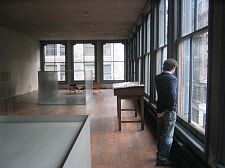
last evening, it was fitting then, after our weekend field trip, to visit Donald Judd's prior home and studio in a 5 story cast iron loft building in Soho with Peter Ballantine, who was an assistant and fabricator for Donald Judd for over 25 years. in my eight years in soho, where i had lived just a few blocks away on West Broadway and was still pre-conscious and ignorant of contemporary art, i had always walked by and wondered why that first floor was so empty, except for a few colored flourescent lights (a sculpture by Dan Flavin).
what was most interesting about our visit was Peter's first hand view of what life had been like here just a few decades ago in Judd's existence, compartmentalized just like his art. we were introduced (at least i was) to concepts that i had never really associated with Judd before -- like how crucially important "authenticity" and "being" were to himself and his sculpture.
to him, the authentic, and already existing, was more important than the often tainted perspective of the artist. he used the raw dimensions of the building itself (windows, openings, etc.) to determine the dimensions of his work. he flew up mexican workers from his complex in Marfa, TX, rather than use urban artisan carpenters, to build a large imperfect slab table that became his table of "court" and official business. his kitchen was more than bare with no drawers and with everything (even the plumbing) left out in the open. he hated to see his sculptures in progress. he resisted drawing or making models, prefering his work to BE, rather than be imperfectly and artificially characterized, just as he despised the artificiality of anything but natural light, or the critic's minimalist label.
as Peter powerfully recounted his experiences and Judd's eccentric life, a friend, who herself is an accomplished performing artist, asked me tongue in cheek, "was he serious?" we both thought about it a second, and of course knew that he was. further, not only was he serious and passionate about his work for Judd, but he had lived it. it *was* his life. just as Judd's own work had been Judd's life. or any good artist for that matter.
there were so many moments of "truth" in that train of thought. the social legitimacy and accepted (or contested) merit of what we *do*. the existential and aesthetic choices we each make to *live* our own lives, and to shape our existence and environs. the effected decisions to make a living as a corporate banker, lawyer, doctor, or classical performer, film-maker, show-man, artist, etc. rich man poor man beggar man thief.
in the fading light of a cool early evening, we walked away from the visit with a new awareness for Judd. and ourselves...
10 Decisions Remain for Supreme Court
10 Decisions Remain for Supreme Court
By LINDA GREENHOUSE
http://www.nytimes.com/2003/06/18/politics/18MEMO.html
WASHINGTON, June 17 — This is tea-leaf reading time at the Supreme Court, and, no, the only subject is not whether any justices are planning to retire.
Inside the building, where the frenzy of retirement speculation is largely though not completely discounted, the current topic is when, and under what circumstances, the court plans to announce the remaining 10 decisions and conclude its current term.
If the recent past is any guide, the justices are planning no more than two more decision days: Monday and Thursday next week. That presents the distinct possibility that landmark rulings on affirmative action, gay rights and commercial speech could all be handed down on a single morning.
It has happened before: people still remember the nine decisions, totaling 446 pages, that the court issued on the last day of its 1987-88 term. Such an outpouring of important but often elusive and contested legal language washes over the nation like a tidal wave, leaving confusion in its wake and agenda-driven spin control to fill in the gaps in public understanding.
Many outside the court assume there is a fixed date for the end of the term that mirrors the statutory starting date of the first Monday in October. But that is not the case. The target for the end of the term has been set by a series of internal markers, officially unacknowledged but verified through long observation.
In the 1980's it was Justice William J. Brennan Jr.'s ferry reservation for his summer visits to Martha's Vineyard. Now it is the annual conference of the United States Court of Appeals for the Fourth Circuit, for which Chief Justice William H. Rehnquist serves as the circuit justice. He never misses it, and is to go to the Homestead Resort in Hot Springs, Va., on June 26.
But the fact is that the end of the term is not really under the court's collective control, despite the best efforts of the chief justice, an exacting manager who has imposed a series of deadlines aimed at avoiding the end-of-term debacles that regularly occurred under his predecessor, Chief Justice Warren E. Burger. In those days, there was often a case or two that the court simply could not manage to decide, meaning that the case had to be restored, embarrassingly, to the calendar for reargument during the next term.
Chief Justice Rehnquist requires all majority opinions to be in internal circulation by June 1. The deadline for circulating dissenting and concurring opinions was Monday of this week. Nonetheless, any justice can request a delay in issuing an opinion — to respond to someone else's recently added footnote, for example.
Justices accord such a courtesy to one another in the knowledge that in some future term, they might be the ones requesting more time. Justice Harry A. Blackmun's extended labor on a 1989 abortion case kept the court in session over an extra weekend, until Monday, July 3.
Such a scenario, which would extend the term into the week of June 30, may be the only prospect for avoiding an end-of-term pileup of legendary proportions next week. The superheated atmosphere was captured today by an announcement from the media relations office at the University of Michigan that if the decisions in the Michigan affirmative action cases come down on Monday, the university's president, Mary Sue Coleman, will be on the court's plaza beginning at 10:30 in the morning to discuss them.
The only problem is that with opinions being announced from the bench at 10 o'clock, in a process that often takes 15 minutes or more, there is almost no chance that either President Coleman or any of her questioners would have had the opportunity to read and absorb them. But she will undoubtedly have an eager audience of television news reporters grateful for a live picture.
Meanwhile, a favorite court-watchers' guessing game is under way — who is writing which opinions? This is a form of card-counting that starts from the premise that the two-week periods in which the court sits for arguments throughout the term result in a fairly even distribution of opinions within each sitting.
Of the 11 cases argued in February, only one is undecided and only Chief Justice Rehnquist has not written a majority opinion. The case, United States v. American Library Association, raises the First Amendment question of whether the government can require public libraries to install antipornography filters restricting Internet access.
If Chief Justice Rehnquist is in fact writing the majority opinion, there is little doubt that the court will uphold the law, the Children's Internet Protection Act. On the other hand, he is one of the court's fastest writers, raising the question of why the decision in what is now the term's oldest undecided case is taking so long. One possibility is that there are many separate opinions, both concurring and dissenting. Perhaps he started out writing a majority opinion but lost the majority along the way.
The justices turned briefly from their labors today to break ground for a major modernization project for the court that will move the police department to a two-story underground annex and upgrade all the building's internal systems. Chief Justice Rehnquist and Justice Sandra Day O'Connor turned ceremonial shovels on the lawn where the excavation will soon begin.
Both justices are the subjects of retirement rumors, and many in the small crowd of dignitaries, sheltered under a tent in the light rain, surely wondered: would either stay around to enjoy the fruits of the five-year $122 million project?
At 73, Justice O'Connor is five years older than the Supreme Court building. Her tone was light, but her words conveyed a certain poignancy when she remarked that when a building turns 70, "we can take the infrastructure and change it and make it like new again," adding, "I wish that were possible for individuals, but it isn't."
Bushworld and Hillaryland
Bushworld and Hillaryland
By MAUREEN DOWD
http://www.nytimes.com/2003/06/18/opinion/18DOWD.html
WASHINGTON -- Once toast in this town, Hillary Rodham Clinton is now the toast of the town. (Or at least the Venus part.)
At a Clintonista déjà vu party last night, Hillary was honored for her sensational debut as the fastest-selling nonfiction author ever. (More than Howard Stern even.)
Even with her "spouse problem," as she wryly refers to it in her book, Hillary's polls have shot up since the publication of her sisterhood-is-powerful political manifesto, cleverly masquerading as confessional victim and self-actualization literature.
The Mars brigade stormed a Bush-Cheney re-election fund-raising kick-off at the Washington Hilton — $2,000 a head for hot dogs, burgers and nachos. The White House wants fat cats to pony up $170 million for the run — a small price to pay for the cut in taxes on dividend income.
The 1,200 Bush donors and White House motorcades snarled evening traffic downtown, perhaps a Machiavellian attempt to prevent Hillary doters from making their way out to the Maryland manse of Lissa Muscatine for Hillary's party.
Ms. Muscatine was chief speechwriter for Hillary when she was first lady, and part of the team that toiled for two years helping the senator stitch together her own account of her own life. With le tout hacks, flacks and Hill pols eager to munch on miniature sirloin burgers and Champagne, many guests were discouraged from bringing spouses. (A celebration of a book about marital rifts should not cause them.)
Even with her "spouse problem," as she wryly refers to it in her book, Hillary's polls have shot up since the publication of her sisterhood-is-powerful political manifesto, cleverly masquerading as confessional victim and self-actualization literature.
Once Hillary was in the White House, besieged with questions about deception and secrecy, and beset by cascading investigations.
Now, George W. Bush is in the White House, besieged with questions about deception and secrecy, and beset by cascading investigations.
This president has weapons of mass destruction problems, whereas the last president had weapons of mass self-destruction problems.
W. must persuade doubters why he knew Saddam was an imminent threat before he made a pre-emptive move on Iraq, even as Hillary must persuade doubters why she did not know that Monica was an imminent threat who made a pre-emptive move on Bill. (If only a drum of chemicals were as easy to spot as a black thong.)
With her book, Senator Clinton is dropping a handkerchief in the 2008 race, signaling another amazing roundelay between the two first families of American politics, the fancy Republicans who strain to be common folk, and the Democratic common folk who strain to be fancy.
The Bushies dismissed the Clintons as "means justify the ends" types, who did as they liked and left a mess for others to clean up.
The Clintons saw themselves as audacious warriors for good, ingeniously grappling with intractable problems like health care.
Now the Democrats want to hold open hearings to see if the Bushies are "means justify the ends" types, who did as they liked and left a mess for others to clean up.
The Bushies see themselves as audacious warriors for good, ingeniously grappling with intractable problems like remaking the Arab world.
Just as the Bushies think Mr. Clinton dropped the ball on Osama and terrorism, the Clintons think the Bushies dropped it on the economy and the disenfranchised. And don't get either side started on Whitewater and Halliburton.
In her book, Hillary writes that the right wing considered her husband illegitimate, then goes on to imply that Mr. Bush is, saying of William Rehnquist: "As the country would later learn in the election-deciding case of Bush v. Gore, his lifetime tenure as a Supreme Court Justice did not inhibit his ideological or partisan zeal."
Just as Bushworld is a macho preserve with a tight über-loyal circle, so Hillaryland is a female preserve with a tight über-loyal circle.
Dick Cheney, Donald Rumsfeld, Newt Gingrich and others have been trying to banish the if-it-feels-good-do-it, McGovernick, hippie ethos of the 60's. In her book, Hillary defends the era: "Some contemporary writers and politicians have tried to dismiss the anguish of those years as an embodiment of 1960s self-indulgence. In fact, there are some people who would like to rewrite history to erase the legacy of the war and the social upheaval it spawned. They would have us believe that the debate was frivolous, but that's not how I remember it."
Yup, she's running, and if you're not part of the solution, you're part of the problem.
Microsoft Sues 15 Organizations in Broad Attack on Spam E-Mail
Microsoft Sues 15 Organizations in Broad Attack on Spam E-Mail
By SAUL HANSELL
http://www.nytimes.com/2003/06/18/technology/18SPAM.html
Microsoft, the world's largest provider of e-mail accounts, filed lawsuits yesterday against 15 groups of individuals and companies that it says collectively sent its clients more than two billion unwanted e-mail messages.
Unwanted e-mail, commonly called spam, has been a fast-growing problem for many e-mail users. The Hotmail service from Microsoft, with 140 million users, has been a fat target for spammers.
The company estimates that more than 80 percent of the more than 2.5 billion e-mail messages sent each day to Hotmail users are spam. It now blocks most of those spam messages.
All of the large Internet service providers, including America Online, Earthlink and Yahoo, have started filing lawsuits against e-mailers that they say are sending spam.
Microsoft's suits represent the largest number filed at one time, and reflect Microsoft's willingness to devote some of its considerable resources to fighting spam. It promised more such actions to come.
"We at Microsoft are ramping up our efforts to combat spam," said Brad Smith, Microsoft's general counsel, at a news conference yesterday.
But many spam experts say that these suits do little to actually prevent spam.
"At the end of the day, this is a drop in the bucket," said Ray Everett-Church, the chief privacy officer of the ePrivacyGroup, a consulting company. He said that the several dozen suits against spammers so far have had no noticeable effect in deterring other spammers.
"Right now the big service providers see spam as a point of differentiation," Mr. Everett-Church said. "And these suits are much more of a marketing campaign than an anti-spam campaign."
Mr. Smith of Microsoft, however, argued that the lawsuits were an important part of a multipronged approach to fighting spam. In addition to lawsuits, Microsoft has introduced software to filter out spam for its MSN Internet access service and will include similar software in the next release of its Outlook e-mail program.
Twelve of the suits filed yesterday were in state court in Washington. They brought claims under both the Federal Computer Fraud and Abuse Act and a Washington State anti-spam law. One suit was filed in California state court, and two were filed in Britain. The defendants include many different business involved in e-mail marketing.
Email Gold Inc. and NetGold, both of Dayton, Ohio, are accused of using spam to sell tools for other marketers to get into the spam business.
VMS Inc. and Proform4life Inc., both of Port Richey, Fla., are accused of trying to sell human growth hormone.
RHC Direct of Murray, Utah, is accused of selling videotapes to enhance job hunting skills using misleading subject headers.
VMS and Email Gold could not be reached for comment.
Robert Caldwell, the president of RHC, denied that his firm was sending spam. All of the recipients of the messages that it sends have requested marketing material, he said. Moreover, all of the messages identify the sender's address and phone number.
"They could have picked up the phone to call us rather than filing a lawsuit," Mr. Caldwell said, noting that he has not had any discussions about the offending e-mail with Microsoft. "All this will do is undermine the ability of legitimate marketers to stand up and say this is what we are doing."
In some cases, Microsoft was not able to identify the sender of the spam. It filed several suits against unnamed John Doe defendants. That tactic allows it to use subpoenas and other techniques to try to identify the senders.
Over the last nine months, Microsoft has diverted some of its investigators who normally track down software counterfeiters to tracking down spammers.
The spam lawsuits mainly challenge aspects of the e-mail messages that Microsoft contends are fraudulent, like deceptive return addresses and subject lines. Microsoft does not argue that sending mail that is unsolicited, but otherwise honest, should be banned.
David Sorkin, a professor at the John Marshall Law School in Chicago, argues that focusing on fraud will not eliminate most of the messages that annoy e-mail users.
"As we clean up the spam, we will leave the door open to more and more nonfraudulent spam, and that will be much worse," he said, adding that a result will be much more unwanted e-mail than users now receive.
Making Trinkets in China, and a Deadly Dust
Making Trinkets in China, and a Deadly Dust
By JOSEPH KAHN
http://www.nytimes.com/2003/06/18/international/asia/18GEMS.html
SHUANG TU, China, June 15 — With his handsome smile and full head of black hair, Hu Zhiguo hardly looks 44, much less gravely ill. The giveaway is his wispy voice, faint from clotted lungs.
One doctor told him he had tuberculosis. Another guessed it was cancer. The final diagnosis, based on the cumulus of gray that clouds his chest X-rays, is a severe case of silicosis, a disease Chinese workers call dust lung.
Mr. Hu got the illness making cheap necklaces and bracelets from iridescent stones like opal, sold by the containerload to United States retailers. Working long days at a factory in booming Guangdong Province, he probably inhaled more quartz dust in 10 years than China's own safety standards would permit in a thousand.
Mr. Hu has now retreated to his hometown here in the rugged hills of Sichuan, where he tried, and failed, to help his wife run a dry-goods store.
"I cannot lift a bag of rice," Mr. Hu whispered one recent evening in the back of the family shop. "I am a wasted man, waiting for death."
China has emerged as Asia's leading exporter of manufactured goods to the United States, but the workers who produce those goods are victims of a surge in fatal respiratory, circulatory, neurological and digestive-tract diseases like those American and European workers suffered at the dawn of the industrial age.
China in that sense is not only recreating the industrial transformation that brought prosperity to Europe, the United States and some East Asian nations. It is also reliving its horrors.
Even by its official count, China already has more deaths from work-related illnesses than any other country or region, including the industrialized economies of the United States and Europe combined.
Last year, 386,645 Chinese workers died of occupational illnesses, according to government data compiled by the International Labor Organization.
The statistics may understate the situation in China's thriving east coast industrial centers, where tens of millions of migrant workers like Mr. Hu produce the bulk of China's exports for well under a dollar an hour without employment contracts, health care plans or union representation.
The company where Mr. Hu worked, called Lucky Gems and Jewelry, is now based at a multibuilding site in Huizhou, about two hours north of the mainland Chinese border with Hong Kong. It employs 3,000 workers, almost all of them from far away provinces, living in dormitories inside a gated campus or in the harsh residential community that lines the unpaved streets and construction sites surrounding the factory.
Its owner, a Hong Kong businessman named Wang Shenghua, was a pioneer in bringing jewelry manufacturing to southern China in the mid-1980's, when he opened his first factory in the mainland's experimental economic zone of Shenzhen.
With Lucky and hundreds of small-scale rival manufacturers, China dominates a labor-intensive industry once scattered widely around East Asia and the Middle East.
Lucky says it takes safety seriously. While the owner, Mr. Wang, declined a reporter's request to talk with him and visit the factory, he appointed a lawyer to answer questions about its safety record. The lawyer, Kang Ziying, said the company has always protected its workers and invested heavily in equipment to prevent workers from contracting silicosis, though he acknowledges there have been some cases of the disease among its employees.
"We have always met the government's standards for safety," Mr. Kang said. "Otherwise, they would not let us operate."
Mr. Hu was a 30-year-old peasant farmer eager to earn a worker's wage when he left his home in northern Sichuan in 1990. He traveled for four days, by train and bus, to Shenzhen. There, he landed a job at Lucky, introduced to the company by a distant relative.
He learned how to cut and sand semiprecious stones like opal, topaz and malachite into hearts, stars, pearls, and diamond shapes that are strung together to make rings, bracelets and necklaces.
Mr. Hu sat shoulder to shoulder with other cutters and polishers in confined workshops. Often working 12- and even 18-hours days, they generated clouds of dust that hung in the air even when windows were wide open and the fans were set to high.
"It was always like dusk inside the factory, no matter how much sunlight there was outside," he said. "It was like a heavy fog. We got used to it."
By the late 1990's, Mr. Hu began having trouble climbing stairs and lifting rocks. He came to dread winter, when a common head cold caused prolonged torment. "If I walked quickly, I would run out of breath right away. If I got a cold, I felt like I was suffocating," he said.
If anyone at Lucky was aware of the risks that workers might acquire diseases from exposure to quartz dust, Mr. Hu says that information was not shared with him. Local doctors first told him he might have tuberculosis, then lung cancer. By late 1999, he felt too weak to continue and took a low-paying job selling fruit on the muddy street in front of the factory.
A short time later, when numerous colleagues began developing similar symptoms, Mr. Hu joined them on bus trips to the provincial capital, Guangzhou, to seek a diagnosis. There, a doctor at a hospital that specializes in occupational diseases suspected that jewelry workers might be developing silicosis in large numbers.
The pulmonary ailment comes from overexposure to silicon dioxide trapped in quartz, minerals, rocks and sand. Though it is one of the oldest known occupational diseases, it has only recently become a priority for Chinese authorities, who now consider it a leading work-related illness.
Despite what Lucky workers described as a campaign by the company to deny the problem, provincial authorities eventually ordered all of Lucky's workers to undergo X-ray exams. How many workers showed signs of the disease is uncertain. At least 50 people claim to have fallen sick at Lucky. What is clear is that the company began battling dozens of workers over medical claims, while installing equipment to improve ventilation.
Mr. Kang, the lawyer, said some of the people seeking compensation were fakers and opportunists who either never worked there or who did not really have chronic illnesses. He acknowledged that the company invested $1 million to improve ventilation at the factory after 2001, but said those were not the first steps the company had taken to clean up the work environment.
Workers tell a different story. In the shadows of the Huizhou plant, where the ear-splitting whine of stonecutting machines pierces the air, about two dozen old friends and colleagues of Mr. Hu rent tiny rooms in restaurants, shops and private homes. They spend their days petitioning the government and gathering evidence to use against the company in court.
"Our boss cares only about the money in his pocket," said Liu Huaquan, a 39-year-old former craftsman at Lucky. In 2001, he was the first worker at the company to have silicosis formally diagnosed, but he is still fighting for compensation.
"You would think he could share a small part of his profits with the workers who got sick," Mr. Liu said. "But he uses his money to deny that we exist."
Two former Lucky managers, Chen Xingfu and Yuan Tianhui, say that shortly after they were told they had silicosis, Lucky demoted them, cut their salaries in half and assigned them to haul rocks to and from a warehouse. The demotions, both men said, were intended to force them to leave the company so it would not be obligated to pay their medical expenses.
They said they resigned because their silicosis made it impossible to do heavy manual labor. They are now suing. Mr. Kang, the company lawyer, said their demotions were performance related.
The company has denied compensation to others who worked for Lucky before 1997, the year the company opened its Huizhou plant. Lucky's old Shenzhen factory has no legal tie to Lucky even though it had the same owner and many of the same workers, the company argued in court.
The Huizhou factory does appear to have improved internal air quality, though workers said the main ventilation system was installed only after the first cases of silicosis were confirmed. Work stations now have vacuum tubes to suck up dust, which is spewed outside through exhaust valves. A light frost of silica crystals covers the factory grounds.
Even so, stonecutters and sanders can be easily spotted at the end of the work day because their company-issued navy blue crew shirts have turned gray from the dust.
The factory failed a safety inspection by the Huizhou Center for Disease Control as recently as last summer. The center's report shows that some work stations had ambient silica concentrations as high as 70 times the standard allowed by the Chinese safety code, which is less strict than related American and European standards by a factor of 20.
Lucky rejected the results of that inspection and arranged a new test by another safety agency last October, which it passed. Workers say the company, informed in advance of the inspection, shut down some work stations before inspectors arrived. The company denies that.
Any improvements came too late for Mr. Hu. Doctors eventually confirmed that he had third-degree silicosis, the most severe form, and he was told that the only way to extend his life was to stop working.
He stayed in Huizhou for two years, living on borrowed money, to force the company to pay his medical expenses. It refused, but eventually agreed to a one-time settlement proposed by the Huizhou government that gave Mr. Hu 200,000 yuan, about $25,000. He returned home.
Half a year later, most of the money is gone. Mr. Hu spent several thousand dollars to open a small grocery to generate income. But he found he could not even stock the shelves without collapsing from exhaustion. When he began coughing up blood this spring, he turned the store over to his wife.
Mr. Hu said he had spent most of the severance on hospital visits and intravenous injections of glucose and sodium chloride, which help relieve the pressure on his chest.
One day last week he called his 16-year-old son to his bedside and told the boy that he had to find a job instead of attending high school as planned.
"I am on the threshold of death and this family must have income," Mr. Hu said. "He cried when I told him and I cried, too. But we are going to run out of money in a few months. There is no other way."
Selling trauma
Selling trauma
by Annie Wang, SCMP PRD
http://totallyhk.scmp.com/thkarts/anniewang/ZZZH0PH10HD.html
LULU'S DEBUT NOVEL Lover's Socks is finally published with a first print of 100,000 copies. Lulu goes on a 10-city book tour to promote it. In every city, with every journalist and interviewer, she repeats over and over again the tales of her sad love story with Ximu who cheated on her and only wanted to take her as a lover not a wife. She is heard on radio, seen on TV and written about in newspapers.
Although Lulu enjoys the attention afforded a rising author, she cannot help but feel a sense of irony about the whole thing. The six-year, on-off relationship with Ximu almost destroyed her confidence and made her look like a failure in the eyes of parents and relatives. But now she is achieving a measure of fame and fortune from the whole sorry story. She needs to smile at readers as she signs copies.
She calls her friend Niuniu. ''Believe it or not, I'm selling my trauma. I guess everything is commercialised. The market is what counts.''
Niuniu, who recently filed a story on the Chinese literary scene, comforts Lulu: ''Nothing is wrong with making a living off one's trauma. Mo Yan, the author of The Republic Of Wine always writes about hungry peasants in his stories. Jung Chang, the author of Wild Swans, tells the stories of three generations of women's suffering. Amy Tan is another who made a bundle by selling sorrowful stories to the West. Look at Hollywood; movies about the Holocaust always do well. Selling trauma has proven to be a good business model to follow.''
After talking to Niuniu, Lulu feels at ease. She thinks to herself, ''After all, everybody else is doing it. What the heck? It's karma perhaps. I was wronged and now I'm paid back.''
A few days later, Beibei, another of Lulu's girlfriends, brings along a Hollywood-based Chinese film agent who is looking for cross-cultural projects. They meet at the lavish St Regis Hotel.
The agent's name is Doug and he gets straight to the point. ''The storyline is great. A Chinese man is dumped in France by his Chinese wife and then he goes back to China and becomes a womaniser who takes revenge on Chinese women. You have done a great job exploring the psyche of Chinese women who abandon their Chinese husbands after moving to the West and the sense of defeat that Chinese men have in the West. But your story is not sad enough.''
''What do you mean?'' Lulu asks.
''From Hollywood's perspective, if a movie is about China and it is not about kung fu, it needs to have some cultural flavours. The sad cultural and political situations in other countries often make Americans feel better about themselves. As long as you can make them feel that way, it's entertaining. So I suggest you add in more about the low status of Chinese women. It's best to include the topics of prostitution and foot binding.''
''But my story is a modern-day story. How can I write about foot-binding, which is no longer being practiced in China?''
Doug laughs. ''What about creating an older woman whose feet were bound - the male character's grandmother or great grandmother, for example. The whole point is to show how backward China was.''
''What about prostitution? Why is it needed?'' Lulu asks.
''Nowadays, even a Nobel Laureate Prize winner has said that prostitutes have inspired him. You see, a lot of Western men come to Asia to get cheap sex. So create an intriguing Chinese prostitute.''
Lulu's anger is quite visible as she gets to her feet. ''Doug, Richard Mason wrote about The World Of Suzie Wong 50 years ago. You Hollywood dream merchants need to update your collections.''
Lulu then gives Beibei a broad wink as she says, ''Let's go girl, we have to meet Niuniu at the opium den.''
The two giggle as they walk off arm in arm.
More Americans Seeking Help for Depression
More Americans Seeking Help for Depression
By MARY DUENWALD
http://www.nytimes.com/2003/06/18/health/18DEPR.html
More than half of the Americans who suffer from depression now seek treatment, up from one-third 10 years ago, a new survey says. Yet nearly 60 percent of the people in treatment do not receive adequate care, the researchers found.
More than 16 percent of Americans — as many as 35 million people — suffer from depression severe enough to warrant treatment at some time in their lives, according to the National Comorbidity Study, sponsored by the National Institutes of Health and published today in a special issue on depression of The Journal of the American Medical Association. In any given one-year period, 13 million to 14 million people, about 6.6 percent of the nation, experience the illness.
The numbers are similar to those found in the first survey 10 years ago. At that time, the lifetime prevalence of depression was measured at nearly 15 percent and the one-year figure at 8.6 percent.
Depression costs employers $44 billion a year in lost productive time, according to a second survey reported in the same issue of the journal. That figure is $31 billion more than the amount lost because of illnesses in people who do not have depression. The participants were asked about their wages and lost hours.
Most of the lost time occurs while people are at work, said the lead researcher, Dr. Walter F. Stewart, an epidemiologist now at Geisinger Health Care Systems in Danville, Pa.
"People are making it to work," Dr. Stewart said. "They're just not engaged in work. They're getting to the door, but then closing it and just not functioning. People have called this `presenteeism,' and it is often invisible to employers."
An important reason that people with depression fail to receive proper care, said Dr. Ronald Kessler, the leader of the N.I.H. survey who is a professor of health care policy at Harvard, is that many people seek help from family doctors, who often do not treat depression aggressively.
"Family doctors are apparently not yet up to speed enough to give good quality care," Dr. Kessler said.
In the survey, which included interviews with more than 9,000 people, treatment was considered adequate if it consisted of at least eight half-hour sessions of counseling with a mental health professional or treatment with antidepressant drugs for at least 30 days, combined with four visits to a doctor.
In some cases, the researchers found, patients with depression were given just 5 milligrams of antidepressant, one-fourth the standard dose.
Dr. Kessler said family practitioners could easily learn to improve their treatments.
"The bigger nut to crack," he said, "has been getting people to come into treatment. And in that area, we've made significant progress."
The director of the National Institute of Mental Health, Dr. Thomas R. Insel, said depressed people often discontinued their treatments.
"Depression," Dr. Insel said, "brings a tremendous sense of hopelessness. When you're in the middle of it, you can't remember that things were ever any better."
The illness displays sadness, hopelessness and difficulty concentrating.
The survey found that women continued to have a higher risk for depression than men, though the gap is narrowing. Women who have had at least one episode of depression outnumbered men 1.7 to 1. Forty to 50 years ago, the ratio was three to one, Dr. Kessler said, and 10 years ago, it was two to one.
Black people are 40 percent less likely to experience depression than Hispanic or white people, the survey said. On the other hand, blacks who develop the disorder are 30 percent more likely to suffer lasting or recurring depression.
People living in poverty are nearly four times as likely to suffer chronic depression as affluent people, the survey reported.
Younger people are also at risk. Among those experiencing depression in a one-year period, three times as many people were from 18 to 29 as were 60 and older.
That depression strikes so early in life is an important reason why it is such a significant health problem worldwide, Dr. Kessler said.
"Hypertension and arthritis start at age 55," he said. "Depression starts at 15 or 25. So the number of years of suffering in a person's life is much higher."
A third paper in the journal focuses on the high rate of doctors' suicides. Although no recent studies of suicide among doctors in the United States have been conducted, doctors in international studies have been found to be significantly more likely to commit suicide than other people of their sex and age.
Although in the general population men are more likely than women to commit suicide, among doctors, women and men are equally at risk.
Because so many American doctors have quit smoking, their health is generally better than that of other people their age.
"Doctors have lower heart disease rates and lower cancer rates," said Dr. Daniel E. Ford, of the Johns Hopkins University Medical Center, an author of the study. "The suicide rate really sticks out there as the one rate that's different."
The numbers suggest that doctors are not as adept as they should be at recognizing and treating depression and mood disorders, said Dr. J. John Mann of the Columbia University Medical Center, president of the American Foundation for Suicide Prevention and another author of the study. "Physicians need to take better care of themselves and translate that into the way they care for their patients."
Dr. Insel, an author of an editorial in the journal on depression, noted that doctors were better at treating the disorder than at understanding it.
"We don't understand the pathophysiology," he said. "And there is no biomarker. We don't have a P.S.A. test for depression."
That was a reference to the blood test used to help diagnose prostate cancer.
A better understanding is crucial, Dr. Insel said, because depression affects the entire body.
"It's not just people feeling lousy," he said. "Depression affects the cardiovascular system, the endocrine system, even bone growth leading to osteoporosis."
Depression develops in one in four people who have had heart attacks. When it strikes, the risk of dying is three and a half times greater than if the victims were not depressed, studies show, making it as great a risk factor as smoking.
A study of nearly 2,500 people, also in the journal, looked at whether treating for depression after a heart attack would improve survival. Treatment, with antidepressants or counseling, was found to reduce depression and improve social functioning, but it did not influence survival.
Dr. Susan M. Czajkowski, a research psychologist at the National Heart, Lung and Blood Institute who is an author of the study, said future studies might find that stronger treatments or therapy at a different time, perhaps before the first heart attack, might make a difference in survival.
"We need another trial," Dr. Insel said. "We need a really serious large-scale study to see whether you're going to save lives in people who've had a heart attack by treating their depression."
At Nude Youth Camp, Skin Is Bare but Lust Is Verboten
At Nude Youth Camp, Skin Is Bare but Lust Is Verboten
By KATE ZERNIKE
http://www.nytimes.com/2003/06/18/national/18NUDE.html
LUTZ, Fla., June 12 — On the third-to-last day of summer camp, the temperature has risen to 98 degrees, and even the troupers have begun to whine.
"I don't want to play strip volleyball!" complained Jane Jeffries, 13, her sunburned shoulders sagging. "I want to play regular volleyball."
Halie Nelson, 14, agreed, "Yeah, I'd rather get all the clothes off, and keep all the clothes off."
Here at the Youth Leadership Camp run by the American Association for Nude Recreation, the dress code for regular volleyball — and for the pudding toss, mini-golf and campfire sing-alongs — is the same as it is for skinny dipping.
Basking in what nudist organizations say is a growing interest in nude recreation, the association has begun a nationwide expansion of summer camps for nudists age 11 to 18. The first began here 10 years ago, in a county north of Tampa known for its concentration of nudist resorts. In 2000, the association opened its second camp in Arizona.
A third is to open outside Richmond, Va., this month, and organizers in Texas are planning a fourth camp there for the summer of 2005.
Naked summer camp might strike non-nudists as illegal or prurient, or like striking a match to the gasoline of adolescent hormones.
Anti-nudity statutes in Florida and other states, however, say that nudity on private property is perfectly legal, even among minors, as long as there is no lewdness. And camp rules, drawn up by campers themselves a few years ago, guard against that. "Do not allow nudity and lust to mingle," they state. "No improper touch. Nudity must not be humiliating, degrading or promote ridicule." Even the occasional clothing, worn in the camp's shuttle van, must not be "sexually alluring."
Nude tourism has grown to a $400 million business this year from a $120 million business in 1992, reports the nudist association, with travel agencies noting a surge in nude cruises and, in May, the first nude charter flight. The association itself is growing, with 30 new clubs, for a total of 267, in the last two years.
There are still few places, however, for teenagers.
"I've spent my life around nudist resorts; this is the first time I've ever been around kids my own age," said Halie, who had been named Camper of the Day the previous night for participating fully despite a foot swollen by a bee sting. "It's either 45 and over or 10 and under."
The campers, many of them alumni of church or scout camps, say they like this better, but not for the reasons most people might expect.
"I learned to play tennis this morning," Amanda Williamson, 18, said. "I never did that at church camp. I'm getting better at volleyball, too."
Aside from the obvious, naked camp looks a lot like other camps: campers play Capture the Flag, catch frogs and leap up when the whistle blows signaling seconds for ice cream. They make s'mores and sing modified campfire songs ("This Land Is Your Land" ends, "This land was made nude and free.") Each camp team writes a song for the annual talent show, with hosts "Sunny and Bare."
Parents and campers say the camp promotes a healthy body image at an age when confidence can crumble, and better relations between the sexes when awkwardness normally prevails.
"In gym class, some of the girls will hide in their lockers to take off their shirts in front of other girls," Halie said. "Sometimes I'll say, `Why are you so insecure?' They all say, `I need to lose a few pounds.' I just don't care about that stuff. I accept my body the way it is."
The nudist association, the larger of two nationwide, sees this as a place to train "youth ambassadors" to what nudists call the "textile" world. (To the question posed by one after-dinner discussion, "I'm a Nudist; Am I a Nut?," the answer, not surprisingly, was no.)
There are things that set this camp apart. Mosquito bites are more irritating, the sunscreen police more vigilant. Campers pack lighter, but drag towels, Linus-like, because nudist etiquette dictates using one when sitting. And the discussion groups feature topics like "Is God Mad at Me Because I'm a Nudist?" (Again, no.)
And everyone is on guard against COG's — "creepy outside guys" — who try to sneak in past the tall fences and security gates, to peek. On Tuesday, when a suspicious-looking man arrived at the pool, counselors quickly herded campers away and guards escorted the unwelcome visitor from the premises.
"It makes me a bit freaked out that people would think of nudity as a sexual thing," said Michelle Jones, 15, a camper from Texas.
Pat Brown, president of the American Association for Nude Recreation, said the camps run extensive background and criminal checks on counselors, often college students who have been nude campers themselves.
Bernie McCabe, the state attorney for Pasco County, where the Lutz camp is, said he had never heard any complaints about it.
Parents seem to have no worries about pedophilia, speaking of nudist camps and resorts as safe, family-like environments.
"Everybody keeps an eye on the children," George Jeffries, Jane's father, said. "There are no transgressions by regular folks coming here, and newcomers are watched very closely."
Still, even parents who have sent their children here for several years do not necessarily tell their church friends or relatives about it.
"If I'm confronted I will not lie, but it's not something I want to have to explain," the father of two boys, an engineer for a telecommunications company, said. "I worry about my kids being ostracized. I believe in this, but a lot of people don't."
The father, like others, said the camp discourages some of the less attractive behavior of adolescents: "I don't have to worry about them sneaking around and seeing things their friends are, the girlie magazines and the porn movies."
Campers agree.
"It takes the mystery out of what the other person looks like, so sex becomes more something you know you're waiting to experience, rather than just a physical thing where you want to find out," said an 18-year-old who gave her name as Jeanene.
"At school, if you see a person, you just see their clothes," Jane said. "Here you have to actually get to know the people."
But some things about teenagers, nudist or not, remain true. Boys at 13 still find scatological humor far funnier than anyone else does. Eleven-year-old girls still fight about who gets to dance as J. Lo in the talent show. Even nudist campers coo at the "cute" swimsuits as they pull on clothing to get back in the van.
Pulling out of one resort during a field trip, a few campers ask the van driver to stop so they can check out the souvenirs. Inside, they finger sarongs and embroidered T-shirts. But they don't buy.
Too expensive.
17 June 2003
Stores Fight Shoplifting With Private Security
Stores Fight Shoplifting With Private Security
By ANDREA ELLIOTT
http://www.nytimes.com/2003/06/17/nyregion/17MACY.html
Steps from the pantyhose section of Macy's Manhattan store sits a cool, halogen-lighted room containing two chain-link holding cells. People, some of them minors, are led to this room every day, where they are body-searched, photographed and then handcuffed to a long steel bench.
An interrogation occurs, and a verdict is made as to whether or not they tried to steal. Their Social Security numbers are punched into a national database, and they are turned over to the police or they are freed. Almost all of them sign confessions and are asked to pay private penalties — five times the amount of whatever they stole.
This private jail, and the policing system that governs it, is replicated to varying degrees in other department stores across the nation with a twofold purpose: to stop shoplifting and to recoup some of the billions of dollars lost to theft every year.
Last year, more than 12,000 people moved through detention rooms in 105 of Macy's stores, including more than 1,900 at the Manhattan store, in Herald Square. Only 56 percent of those people were sent to the police. The company, though, says that over 95 percent of those detained confess to shoplifting and quite a few pay the in-store penalty before leaving. The Manhattan store lost $15 million to theft last year.
The operation is legally authorized, and, retailers say, necessary: private police fill the void left by public police too burdened to chase small-time thieves. Private police also save retailers legal costs by helping them settle shoplifting cases directly with the perpetrators .
But the elaborate systems like the one at Macy's in Manhattan — which includes 100 security officers, four German shepherds, hundreds of cameras, and a closed-circuit television center reminiscent of a spaceship control room — have highlighted a concern shared by a range of people, from civil libertarians to individual shoppers who have been detained, and even to some law enforcement officials.
Whether guilty or innocent, these critics say, those accused of shoplifting are often deprived of some of the basic assurances usually provided in public law enforcement proceedings: the right to legal representation before questioning, rigorous safeguards against coercion, particularly in the case of juveniles, and the confidence that the officers in charge are adequately trained and meaningfully monitored.
Private security operations in the retail world, like those in gated communities, amusement parks and sports stadiums, have grown in number over the last three decades yet remain largely shrouded from public scrutiny.
"The issue of private security guards is a difficult one," said Donna Lieberman, executive director of the New York Civil Liberties Union. "On the one hand, stores have an interest in protecting their business. But on the other hand, security guards have neither the training nor the same legal obligations as police officers and the danger of interfering with individual rights is huge."
Some retail chains have less-elaborate detention areas, using storage rooms or offices instead of jails, and some stores have more direct and regular dealings with police. Wal-Mart's policy, for instance, is to always contact the police when its security guards detain a suspected shoplifter, a company spokesman said. But aggressive policing is a daily staple of the retail industry, with most major retail stores employing some version of the detention and civil recovery procedures used by Macy's.
"That's standard operating procedure in virtually every store in America," said Dr. Richard Hollinger, a sociologist and criminologist at the University of Florida who compiles information about theft-prevention tactics from stores nationwide for a yearly report.
Law enforcement officials in New York, including the state attorney general, said they knew very little about the details and scope of the kind of security operation being run at Macy's. Officials in Attorney General Eliot Spitzer's office were not aware of any complaints against retail security operations, but have investigated other forms of private policing and said the practice can lead to serious problems.
The security operations in place at stores like Macy's have provoked litigation. Last month, Macy's was sued by a Bronx paralegal and other people with a range of claims about how Macy's polices shoplifting — from racial profiling to false imprisonment. They are represented by Kenneth P. Thompson, a former federal prosecutor.
In 1997, a jury awarded another shopper, Paula Hampton, $1.16 million for race discrimination when she was detained at a Kansas Dillard's store. That same year, a jury ordered Eddie Bauer to pay $1 million to three men in Maryland for false imprisonment and other charges.
A Look Behind the Scenes
Macy's officials said the recent charges against them were reckless, and they ardently defended their security practices as lawful, professional and exacting in their ability to weed out thieves among innocent shoppers. To counter allegations of unfairness, the store allowed a reporter wide behind-the-scenes access to its Manhattan store, the company's flagship.
To tour the store is to appreciate the immense security challenge faced by Macy's, as well as the potential for intimidation among those detained.
Plainclothes "detectives" roam the 10 selling floors, keeping in contact with uniformed guards by radio. The movement of shoppers is tracked by over 300 cameras, some controlled by joysticks, as security workers watch images on dozens of closed-circuit television monitors.
Those shoplifting suspects caught and detained are taken to "Room 140," which features a long steel bench bolted to the linoleum floor. A dozen handcuffs hang off the bench from chains. In two holding cells, roughly 5 feet long by 5 feet wide, wooden benches bear the etchings of former detainees. "Not worth it," reads one.
Macy's policy is to call the police if anyone requests legal representation or asks to be set free immediately, but most people prefer to settle the matter privately, officials said.
No department store is legally required to provide the same safeguards as are the police. Legal experts say that retailers are held to a standard somewhere in between that of the police and that of citizens making an arrest — a standard known as merchants' privileges, which allow stores around the nation to detain people on suspicion of shoplifting without police involvement.
"We at Macy's East are sensitive to the fact that we're not a police force operating in the criminal justice system," said Thomas Roan, group vice president for security at Macy's East. "Therefore we raise the standard for detention" above the one used by the police to detain and question people.
The jail is not excessive, Mr. Roan said, given the number of altercations with shoplifting suspects. In the last four months, 25 people have assaulted security officials, 10 of whom required medical attention, Mr. Roan said. In about half of all apprehensions, weapons are recovered, including knives and guns, he added.
But the main reason for such a sophisticated system is to fight the enemy of theft. Some 60,000 people pass through the flagship store every day — and on heavy shopping days, double or triple that number. About $100 million was lost last year to thieves in the 105 stores in the Eastern United States that make up Macy's East.
As a result, Macy's spends roughly $28 million a year on security — $4 million at the flagship store alone.
In an attempt to recover some of the loss, Macy's has a target of $1.4 million in civil penalties it expects to receive this year — the same amount received last year. To achieve that, it uses a formidable weapon used by stores around the nation: civil recovery statutes.
These laws allow retailers to hold shoplifters liable for the cost of catching them and for the losses they cause, charging penalties even if an item is recovered in perfect condition. In New York, the statute is especially powerful, allowing stores to demand five times the value of the item stolen, whether or not there is a confession, and to pursue that claim even if the case is tried criminally and thrown out.
"Retailers have abandoned the criminal justice system because they know the system is not interested in them as a victim," Dr. Hollinger said.
But it is the manner in which Macy's enforces its pursuit of shoplifters, backed by these statutes, that is at the heart of the dispute between Macy's and critics of private security.
A Five-Step Approach
The store has a program to train its guards to follow five steps before detaining a person: they must watch the person enter a department, select merchandise and conceal it; then maintain unbroken surveillance to establish that the item is concealed; and then watch the person attempt to leave the store without paying.
"Nonproductive detentions" — the company's phrase for innocent people wrongly detained — occur less than 1 percent of the time, and result in disciplinary action, store officials said. Thirty-two security guards were fired last year from Macy's East stores for wrongly detaining 66 people, and 43 other security associates were disciplined.
But the suit brought last month by Sharon Simmons-Thomas, and others, who are represented by Mr. Thompson, a partner at the Manhattan law firm of Thompson Wigdor & Gilly, paints a much more menacing picture.
The detention system is predatory and racially biased, Mr. Thompson claimed, with security guards using racial codes to alert one another that a minority shopper has entered an area.
The lawyers said that 13 current or former security officials at Macy's have assisted in the lawsuit. One former worker, who spoke on the condition of anonymity for fear of reprisal, said he thought the store set quotas for how many people should be detained on a given day. "At one time they put the numbers on the walls," said the man, who worked at Herald Square and left in a dispute.
Macy's officials called the charges baseless: officials do use numbers of detentions from the previous year as a guide to what kind of activity to expect, they said, but not to pressure guards; security officials must sign a code of conduct that prohibits racial profiling; and race and gender codes are used only for description purposes when guards communicate among themselves.
But the question of what happens once people are detained has provoked the greatest concerns.
In the in-store jail, most people confess that they stole once presented with evidence, Macy's security officials said. If they sign a confession, the store gives them the option of paying their penalty right away. Those who confess also sign a notice that allows the police to charge them with a felony if they are caught shoplifting in the store again.
But because the confessions are won in secret, and by officials with far less experience than government police departments, many regard them as potentially suspect.
"If someone is arrested by police, they know they're going to court, they know they're going to get a lawyer, they know they're going to tell their story to a judge, they know if they're innocent that within a short period of time they're going to be talking to someone who can help them," said Susan Hendricks, deputy attorney in charge of the criminal defense division of the Legal Aid Society.
The former security official said people were given the impression that if they signed confessions, they would not be prosecuted.
Who Gets Prosecuted
"This is how they give them a light at the end of the tunnel that this might end at the store," he said.
Macy's security officials said they painstakingly trained their staff to first decide whether to prosecute a person before the issue of civil recovery is broached.
Discretion is used in whether to prosecute a shoplifter based on a range of "mercy" factors, including a person's age and health and whether the person has been cooperative. Sometimes, the local police tell Macy's security they are too overbooked to process any more cases, Macy's officials said.
New York police officials denied this. "When we are called, we respond," said Lt. Brian Burke, a department spokesman. But another police official acknowledged that if large department stores chose to call the police every time they caught someone shoplifting, the department would be swamped.
The current lawsuit against Macy's includes the kind of disputed account that many regard as unsurprising in the world of private security.
A Disputed Transaction
Two other plaintiffs, Barbie Sanchez, 16, and Jennifer Velez, 17, who are longtime friends, said they visited the flagship store last Oct. 5 to exchange a pink blouse for Miss Sanchez's mother, but were unable to because they lacked a receipt. When the girls tried to leave, they say, security guards stopped them, grabbed their shopping bags and led them to Room 140.
The girls said they were pressured to say they had stolen the blouse and other clothing. After two hours, the girls said, a man told them to sign some forms or they would be "in more trouble."
They signed the forms. Soon, they received letters from a Florida law firm, retained by Macy's to collect on its behalf, seeking more than $400.
"If we shoplifted," Miss Velez asked in an interview, "why didn't they send a cop to pick us up? They think you have no rights."
A lawyer for Macy's said he could not comment on the girls' specific claims because of the litigation.
He did say, though, "We are absolutely confident when all the evidence is in, it will be clear that we follow our policies and only detain people that we see stealing and attempting to leave the store."
Is Gotham Ready for Mayor Clinton?
Is Gotham Ready for Mayor Clinton?
By Howard Kurtz
Washington Post Staff Writer
Friday, June 13, 2003; 8:31 AM
http://www.washingtonpost.com/wp-dyn/articles/A54151-2003Jun13.html
We are bringing you another Clinton rumor this morning.
Not about Hillary. She's gotten enough publicity this week.
Not about sex. We've all had enough of that.
About Bill.
That he just might, maybe, possibly, want to run for office again.
After musing about how that darn 22nd Amendment ought to be changed so young ex-presidents can run again, maybe he will just find a job for which there is no constitutional bar. Such as mayor of New York.
Instead of dealing with Tony Blair and Jacques Chirac, he can grapple with Freddy Ferrer and Al Sharpton. Instead of nuclear missiles, he can deal with parking and potholes. The job doesn't have its own plane, but you do get police escorts and a nice white house, Gracie Mansion.
Clinton in '05? Why not? It beats sitting around waiting for his wife to reclaim his old job in '08. And membership in the Senate spouses club with Bob Dole doesn't sound too exciting.
Okay, there are a few holes in this scenario. Clinton now makes zillions of dollars, including big bucks on the lecture circuit. As mayor he'd have to give speeches for free – and settle for a $195,000 salary.
He'd occasionally have to ride the crowded and sweaty subway, like Mike Bloomberg, just to show he's in touch with da people.
He'd have to wolf down plenty of hot dogs and knishes on the campaign trail (okay, maybe not such a disadvantage).
And what if Mayor Bill demands more federal aid for the Apple and Hillary votes no? Will there be more shouting matches?
The latest buzz – and that's all it is – was started by an item in Washingtonian magazine. New York Times metro columnist Joyce Purnick picked up on it:
"You scoff. Well, of course, you scoff. There is plenty about which to scoff.
"Odds are it will not happen. But on the theory that New York is home of the improbable, that it is a place where a first lady can become a United States senator and a billionaire with political talents in inverse proportion to his wealth can become mayor, let us consider this latest bit of political gossip for a moment.
"It is too enticing to let go, especially since the former president hasn't rejected the idea. A New York Democrat who urged him to run this week reports that while he didn't say yes, he didn't say no. Being polite? Enjoying the attention? 'He's busy running his foundation, not running for office,' his spokesman, James E. Kennedy, said.
"The latest round of Clinton speculation surfaced in the June issue of Washingtonian magazine. The thinking: Mayor Michael R. Bloomberg is not popular, no compelling Democrats are lining up to challenge him, Mr. Clinton is in limbo, New York loves him and there is no other job large enough for his talents or ego...
"The mere idea of a Bill Clinton candidate really does fuel the image machine. Thoughts of fun again at City Hall. Of roiling neighborhood meetings where regular folks from Tottenville to Pelham Parkway could confront a former president about their corner traffic light. One would pay admission to watch him anticipate a transit strike or tangle with the State Legislature. If the economic slump continued, a Mayor Clinton would surely perpetuate the Bloomberg policies of keeping taxes high rather than decimating services."
Bloomberg, for his part, is suggesting that Clinton remain in the private sector. Or as the New York Daily News puts it:
"Mayor Moneybags to Bubba: Eat my dust!
"Responding to media speculation that former President Bill Clinton might run for mayor in 2005, Bloomberg declared, 'I will get reelected.'
"'I welcome lots of competition. If President Clinton wants to run for mayor, I can tell him it's a very challenging job. But it's a great job. And I would recommend it to anybody,' Bloomberg said.
"However, the mayor added, 'I sort of recommend that he thinks about it for the next six years, because he'd have a tough time winning before that.'"
But a New York Times poll this morning makes clear why there might be a job opening, with New Yorkers bummed about tax hikes and service cutbacks:
"Those negative feelings appear to have colored New Yorkers' views of Mayor Michael R. Bloomberg. Only 24 percent of those polled said they approved of the job he was doing, the lowest approval rating for a mayor since The Times began taking polls on mayoral performance in 1978."
Dick Morris, continuing to slam Hillary, reminds us on National Review Online that politics is a contact sport:
"Dear Hillary, In your new book, Living History, you correctly note that when you asked me to help you and Bill avert defeat in the congressional election of 1994 I was reluctant to do so. But then you assert, incorrectly, that my reluctance stemmed from difficulties in working with your staff. You even misquote me as telling you: 'I don't like the way I was treated, Hillary. People were so mean to me.'
"As you know, I never said anything of the sort. I had, in fact, no experience in dealing with either your staff or the president's at that point, and had not yet met Leon Panetta or George Stephanopoulos. My prior dealing with Harold Ickes had been twenty five years earlier.
"The real reason I was reluctant was that Bill Clinton had tried to beat me up in May of 1990 as he, you, Gloria Cabe, and I were together in the Arkansas governor's mansion. At the time, Bill was worried that he was falling behind his democratic primary opponent and verbally assaulted me for not giving his campaign the time he felt it deserved. Offended by his harsh tone, I turned and stalked out of the room.
"Bill ran after me, tackled me, threw me to the floor of the kitchen in the mansion and cocked his fist back to punch me. You grabbed his arm and, yelling at him to stop and get control of himself, pulled him off me. Then you walked me around the grounds of the mansion in the minutes after, with your arm around me, saying, 'He only does that to people he loves.'"
Salon's Joe Conason challenges Morris's account.
Slate's Chris Suellentrop finds the non-sex parts of the book a bit of a snooze:
"Even if you turned every page you wouldn't find a thing on Marc Rich, or the 1996 fund-raising scandals, or any indication at all of what kind of 'pain' Bill had caused in their marriage before the Lewinsky scandal. The book is as comprehensive as a hubristic family Christmas letter: 'I headed a panel on health care, and Chelsea and I traveled to India, and Bill went golfing with Greg Norman! Oh, and on a trip to Denver, two guys mooned us!' It's not much more than a timeline encrusted with uninteresting anecdotes.
"In part, it's the book you would expect from Hillary – on-message, with laundry lists of her husband's accomplishments and references to her own importance in the White House, plus tirades against the evil Republicans who plotted to stop them. It's part policy brief, part presidential-campaign biography (her potential future one, that is), and part chronicle of the obstacles that faced a smart, ambitious woman during her climb to the top. In many ways, the descriptions of her life before Bill Clinton are the most interesting, even if, as a child and a young woman, Hillary Rodham was exactly the type of kid you would have imagined her to be: safety monitor in grade school, selected to serve on school committees by her high-school administration, president of her college government. She never wanted to be just a girl.
"But she never got to be one, either. At least, not until she reached the White House. There, she finds that she's expected to embody the feminine ideal during a time when no one's quite sure what that ideal is. She complains about the 'pressures on me to conform' to gender stereotypes while she was first lady of Arkansas, and she approvingly quotes Martha Washington on the difficulties of being America's first lady."
Tom DeLay said it ain't gonna happen, but it happened yesterday, although it could always sink in the congressional bog:
"Bowing to political pressure," the Wall Street Journal reports, "the House approved additional tax breaks for low-income families with children, but strong opposition from conservative Republicans makes the outcome uncertain.
"The House bill, approved 224-201 mostly along party lines, would amend last month's tax-cut legislation so low-income families receive a boost in the child-tax credit to match roughly what families with higher incomes are getting. The $3.5 billion provision was dropped from the original bill by Republican negotiators, spurring a barrage of negative publicity."
But the House measure costs another $82 billion, which could be a way of ensuring it really ain't gonna happen.
The media are in full cry about the likelihood of two upcoming Supreme Court vacancies. But USA Today says one of the jurists looks like he's not going anywhere:
"Chief Justice William Rehnquist, 78, has hired a staff for the court's next annual term, which begins in the fall. He also has accepted speaking engagements into November. ...
"Perhaps most important, Rehnquist's court has scheduled a hearing on a key campaign-finance dispute for Sept. 8. ... Some legal analysts say the court's scheduling of such a sensitive, important case for early September is the clearest indication yet that Rehnquist does not plan to step down this year."
The press continues to chip away at Bush's WMD arguments, as in this Philadelphia Inquirer piece:
"Making his case for war with Iraq, President Bush in his State of the Union address this year accused Saddam Hussein of trying to buy uranium from Africa, even though the CIA had warned White House and other officials that the story did not check out.
"A senior CIA official, who spoke on condition of anonymity, said the intelligence agency informed the White House on March 9, 2002 – 10 months before Bush's nationally televised speech – that an agency source who had traveled to Niger could not confirm European intelligence reports that Iraq was attempting to buy uranium from the West African country.
"Despite the CIA's misgivings, Bush said in his address: 'The British government has learned that Saddam Hussein recently sought significant quantities of uranium in Africa.'
"Three senior administration officials said Vice President Cheney and some officials on the National Security Council staff and at the Pentagon ignored the CIA's reservations and argued that the president and others should include the allegation in their case against Hussein. The claim later turned out to be based on crude forgeries that an African diplomat had sold to Italian intelligence officials."
Not pretty.
Andrew Sullivan hurls perhaps the ultimate insult at the GOP over WMD:
"The Republicans are dumb and paranoid to try and stop a full-fledged investigation into the intelligence findings that provided the basis for one of the main arguments for the war against Saddam. It's important that any flaws in intelligence are fully explored; and any hype that might have been added to the data should be fully exposed and examined. If the administration has nothing to hide – and I doubt it has – let the light in. These Republicans are acting like, er, well, the Clintons."
Sullivan links to a New York Observer piece in which Francine Prose wonders about a future memoir from this president:
"'I could hardly breathe. Gulping for air, I started crying and yelling at Donald and Dick and Condoleezza: 'What are you saying? Why did you lie to me? What do you mean, there were no weapons of mass destruction?'"
In Salon, San Francisco Mayor Willie Brown blasts the press for its coverage of 43:
"Bush's responses are so programmed it's unbelievable the national media allows him to get away with it. You realize there's no time Bush has to face the people like Tony Blair does regularly? There's no prime minister's hour in this country? Now, in the past, it's been the press who's been the opposition, so to speak, questioning the president – but Bush has been careful not to present himself to the press in that fashion. [After that last scripted press conference] news organizations should have simply stopped covering him on such a programmed basis. But instead, they got programmed into the war – programmed into the tanks, which utterly ruined any objectivity. The press is gone. The free press in America has been compromised. But they loved being out with the generals. It became so apparent that they'd been pimped."
You can tell he's not running for reelection.
Speaking of mayors, you know who's REALLY enjoying the recent travails at the New York Times? Politicians!
"Mayor Richard Daley could barely contain his glee about the plagiarism scandal that touched off the journalistic equivalent of an earthquake," says a Chicago Sun-Times piece.
"For once, the shoe was on the other foot. The spotlight was on deception and fraud by those who cover the news--not on the politicians they love to put on the hot seat.
"Daley was loving it. Like Arizona Diamondback Mark Grace gloating about former teammate Sammy Sosa's corked bat, the mayor couldn't wipe the smile off his face.
"'When you question a politician, people are going to question your credibility in journalism--and they should. Why not? You question me. They should question you. You should not be separate or immune from this,' Daley said.
"'You question religious organizations on a lot of issues. When someone questions you--talk about the [code of silence by] the men in blue. The men and women in your industry just tie up together [saying], "You can't criticize us." You criticize everyone else, but you cannot take the heat. There's credibility in every profession. But when it comes to you, none of you can take the heat.'"
Whew! We're sweating.
American Prospect's Michael Tomasky examines the issue we explored yesterday: Why don't Bush's political problems resonate?
"The question for Democrats now: How to make Americans care?
"We're living in times that I don't even know how to describe. It's pretty hard to understand what's happening in this society when the majority leader of the House of Representatives makes use of a presidential agency for the nakedly political purpose of hunting down some home-state legislators. And when that agency complies with the request. And when it's a little two-day story, not a scandal at all. One doesn't even have to ask, in this case, the hypothetical that liberals are prone to present – to wit, imagine if the Clinton administration had been involved in something similar. No; this would have been a scandal, and properly so, if it involved a federal agency under any administration from Bill Clinton to Dwight Eisenhower. But not now. ... "
Bush "and his servants were out on the hustings selling the American people a story about an imminent threat that did not exist in order to gin up public support for sending young Americans off to risk death. Hey, why lose sleep over that?
"But again: How to make people care? Let's face it: It may be that they never will. For most Americans, the bottom line will be that we won. Even if no weapons of mass destruction are found, Bush will essentially say, as he has already, What the heck, the Iraqi people are free. And most Americans will probably accept that, especially with the media – including a few prominent liberal columnists – urging them to do so."
Rare Bosnia Success Story, Thanks to U.S. Viceroy
Rare Bosnia Success Story, Thanks to U.S. Viceroy
By MARK LANDLER
http://www.nytimes.com/2003/06/17/international/europe/17BOSN.html
BRCKO, Bosnia and Herzegovina, June 13 — A decade ago, Samira Hasanvasic said, her parents huddled in a nearby village as Bosnian Serbs hunted down Muslims, torching their houses and driving many into exile. Others they killed, dumping the bodies into the muddy shallows of the Sava River.
This week, Ms. Hasanvasic, 17, completed her second year in a high school that integrates Muslims, Serbs and Croats — children of the groups that fought so bitterly over the right to live apart. It is the only city in Bosnia where the three main ethnic groups are mandated to go to school together.
"At first, everyone was afraid because of what happened during the war," said Ms. Hasanvasic, gesturing to her friend, Romana Stjepic, a Croat. "But then we got to know each other, and the fear went away."
Ms. Hasanvasic still dreams of leaving her hometown behind, but not because it was a killing ground. For her, Brcko (pronounced BIRCH-ko) is just run-of-the-mill boring.
Brcko's transition from deadly to merely dull is a remarkable success story — one of the few in the years that foreigners have been trying to fix this broken land, and one that offers lessons for the United States as it embarks on its latest effort at nation-building in Iraq.
"This was a snake pit, the worst place you could imagine in Bosnia," said Mark Wheeler, director of the Bosnia Project at the International Crisis Group, a research group. "But the international community equipped people with enough authority to get their jobs done."
Today, this river port of 85,000 on the northeastern border of Bosnia has the highest per capita income in the country, a balanced budget and a skyline alive with construction cranes. Ethnic tensions, while not gone, seem to have been relegated to the status of a distraction for which the busy people have no time.
Some of Brcko's success is due to money. Treated as an international protectorate since the war, it has received $2 million a year in direct American aid, plus an estimated $65 million in other foreign aid.
Yet dollars alone do not explain the rebound. Bosnia as a whole has been flooded with anywhere from $5 billion to $15 billion — more precise estimates are hard to come by — and it still languishes.
The lesson of Brkco, Mr. Wheeler said, is that would-be nation-builders should install a powerful interim administrator, who is unafraid of defying the local political bosses. With a whip and some cash in hand, this proconsul can override ethnic loyalties and turn local attention to establishing the rule of law and business-friendly policies.
Henry L. Clarke, an American diplomat who became Brcko's third supervisor in April 2001, turned the tide. He has imposed one law — on integrating the schools — over the objections of the city council. He has annulled two others, dismissed local officials and business chiefs, and rammed through reforms.
"The powers are broad, I won't deny that," Mr. Clarke said over dinner. "But the way you get reforms done is with the cooperation of the people. You don't get it by acting like a little Tito."
As for elections — a perennial concern of American officials — they have simply not taken place for local posts here. The people of Brcko have voted, largely along ethnic lines, in the four national elections that have been held in Bosnia since 1996. But they have not elected a single city official; instead, the supervisor appoints the city council.
"Thankfully it didn't happen," Senad Pecanin, editor of the weekly magazine Dani, said of local elections.
"The worst mistake we made in Bosnia was insisting on early elections," he said. "They just confirmed the results of the war in political terms."
Brcko's progress has been so good that Paddy Ashdown, a British politician who last year became the latest European to take on the office of high representative of the international community, said, "I looked at Brcko and thought, `That's what we ought to be doing,' and I used my powers in a similar fashion."
Bosnia as a whole, however, remains a ruin. Dragged down by old Communist structures and largely destroyed by the war, the economy suffers from mountainous deficit. Elections entrenched corrupt leaders, who stymied economic reforms.
Ironically, Brcko has avoided that general fate precisely because it was so disputed between Muslims, Serbs and Croats that its fate could not be decided at peace talks in 1995.
Finally, an international tribunal ruled that Brcko would be run as a separate district, with an appointed local government and an outside American supervisor who would be fortified with broad powers.
"The U.S. reaction was: `Oops, we just took on one of the blackest holes in Bosnia. We can't let this fail,' " Mr. Clarke said.
The colony they took over was a shambles. More than 9,000 houses, a third of the total housing stock, had been destroyed during and after the war. The town's port was moribund, its food-processing plants were rusting hulks, and land mines lurked in the surrounding fields.
Perhaps because of his mild manner, Mr. Clarke has stirred little open resentment in Brcko. The Serbian mayor, Sinisa Kisic, describes him as an "adviser rather than one who orders." Only when he forcibly integrated the schools did he provoke a backlash among Serbs, some of whom dubbed the decision "Clarke's Law." Even then, they put up no violent resistance.
Mr. Clarke's latest project is the Arizona Market, a collection of sprawling, seedy stalls on the edge of town. When Arizona first sprouted after the peace accord was signed, it was hailed as hopeful because Serbs, Muslims and Croats met there for trade and business deals that had ceased during the war.
But now Brcko's city council has given control of the land to an Italian developer, who is investing more than $100 million to turn Arizona into a modern shopping center.
Critics have a cynical take on Mr. Clarke's activism: that he keeps inventing new jobs to avoid leaving. "The Americans don't want elections because they're afraid the bad guys will win," Mr. Wheeler said.
Mirsad Djapo, a local Muslim leader, noted that in the last national election, Brcko's citizens voted for the Serbian nationalist party in greater numbers than Serbs nationally. "We must have elections, but there is always a risk," he said.
And Brcko remains awash in guns. American soldiers go door to door these days, selling raffle tickets for the chance to win a Volkswagen car in return for residents' handing in their weapons. On a recent morning, they collected five hand grenades.
Mr. Clarke said he would not be rushed into packing his bags. But he agrees in principle with Mr. Wheeler's suggestion that Brcko hold elections in October 2004 to coincide with local elections throughout Bosnia.
The debate over democracy stirs little interest among young people here. When Brcko devised a new curriculum for its schools, it scaled back history in favor of subjects like mathematics and computers.
"We're young, and we don't know anything about the war," said Marko Jurocivic, a 17-year-old Serb. "Our history class ends with World War II."
Inmates Released from Guantánamo Tell Tales of Despair
Inmates Released from Guantánamo Tell Tales of Despair
By CARLOTTA GALL with NEIL A. LEWIS
http://www.nytimes.com/2003/06/17/international/asia/17PRIS.html
KABUL, Afghanistan, June 16 — Afghans and Pakistanis who were detained for many months by the American military at Guantánamo Bay in Cuba before being released without charges are describing the conditions as so desperate that some captives tried to kill themselves.
According to accounts in the last three months from some of the 32 Afghans and three Pakistanis in the weeks since their release, it was above all the uncertainty of their fate, combined with confinement in very small cells, sometimes only with Arabic speakers, that caused inmates to attempt suicide. One Pakistani interviewed this month said he tried to kill himself four times in 18 months.
An Afghan prisoner who spent 14 months at the camp, at the American naval base at Guantánamo, described in April what he called the uncertainty and fear. "Some were saying this is a prison for 150 years," said Suleiman Shah, 30, a former Taliban fighter from Kandahar Province in southern Afghanistan.
None of those interviewed complained of physical mistreatment. But the men said that for the first few months, they were kept in small wire-mesh cells, about 6 1/2 feet by 8 feet , in blocks of 10 or 20. The cells were covered by a wooden roof, but open at the sides to the elements.
"We slept, ate, prayed and went to the toilet in that small space," Mr. Shah said. Each man had two blankets and a prayer mat and slept and ate on the ground, he said.
The prisoners were taken out only once a week for a one-minute shower. "After four and a half months we complained and people stopped eating, so they said we could shower for five minutes and exercise once a week," Mr. Shah said. After that, he said, prisoners got to exercise for 10 minutes a week, walking around the inside of a cage 30 feet long.
In interviews at their homes, weeks after being released, he and the freed Pakistani detainee talked of what they said was the overwhelming feeling of injustice among the approximately 680 men detained indefinitely at Guantánamo Bay.
"I was trying to kill myself," said Shah Muhammad, 20, a Pakistani who was captured in northern Afghanistan in November 2001, handed over to American soldiers and flown to Guantánamo in January 2002. "I tried four times, because I was disgusted with my life.
"It is against Islam to commit suicide," he continued, "but it was very difficult to live there. A lot of people did it. They treated me as guilty, but I was innocent."
In the 18 months since the detention camp opened, there have been 28 suicide attempts by 18 individuals, with most of those attempts made this year, Capt. Warren Neary, a spokesman at the detention camp, said today. None of the prisoners have killed themselves, but one man has suffered severe brain damage, according to his lawyer.
The prisoners come from more than 40 countries, and include more than 50 Pakistanis, about 150 Saudis and three teenagers under 16, a majority of them captured in Afghanistan, said Dr. Najeef bin Mohamad Ahmed al-Nauimi, a former justice minister in Qatar, who is representing nearly 100 of the detainees.
Dr. Nauimi represents many of the Saudis, and American lawyers represent about 14 prisoners from Kuwait. There are also 83 Yemenis, he said, and a sprinkling of others, including Canadians, Britons, Algerians and Australians, and one Swede.
Since January 2002, at least 32 Afghan prisoners and three Pakistanis have been released from Guantánamo Bay. Five Saudis were recently handed over to the Saudi authorities. Yasser Esam Hamdi, an American-born Saudi, was moved from the camp to a military brig in Norfolk, Va., in April 2002. Captain Neary said 41 people had been released in all, but he could not give a more exact description.
At the same time, the military is preparing to place about 10 of the prisoners before a military tribunal soon, officials said this month.
Mr. Muhammad, who spent 18 months in Cuba before his release, said that "when they first took us there they would not let us talk, or stand or walk around the cell.
"At the beginning it was very hard to bear," he added. "There was no call to prayer, and there was no shade. In the afternoon the sun came in from the side."
Under the current routine, a majority of the prisoners remain in their cells but for two 15-minute periods a week, in which they walk around the cage and take a shower. In addition, the call to prayer is played over the prison's loudspeakers five times a day, according to Capt. Youseff Yee, the Muslim chaplain who oversees the religious needs of the Guantánamo prisoners.
Conditions improved after the first few months, and prisoners were moved to newly built cells with running water and a bed, Mr. Shah said. Interrogation was sporadic and it varied in length and intensity. Sometimes they were questioned after 10 days, or 20 days, and then not for several months, prisoners said.
But it was the uncertainty and fear that they would be there forever that drove many of them to despair, prisoners said.
"All of the people were worried about how long we would be there for," Mr. Shah said. "People were becoming mad because they were saying: `When will they release us? They should take us to the high court.' Many stopped eating."
One Taliban fighter from the southern province of Helmand, who only uses one name, Rustam, said in May that he was driven to trying to hang himself because he was in a block of Arabs and Uzbeks he described as "crazy."
"There were some very strange people, they were hitting their heads on the wall, insulting the soldiers, and that is why I hated it," said Rustam, who is 22, in an interview in an Afghan prison in Kabul. "I think they were really crazy people, and that's why I kept asking to be taken out for questioning."
When he tried to hang himself, Rustam said, the guards found him quickly. "They untied me and said `Don't do this,' " he said. "They gave me medicine, but it was no good. They put me under supervision and moved me to another place."
Mr. Muhammad, one of three Pakistani prisoners to be released at the end of April, said he first tried to hang himself because for months on end he was surrounded by Arabs and could not speak their language.
"It was difficult not talking to anyone for so long," he said. "It was because of the jail. They put me in a block full of Arabs, they were only letting us out for a very short time, and it was very difficult. I could feel myself going down."
After 11 months in the prison camp, he tied his bedsheet to a ceiling wire and hanged himself from it at 4 o'clock one afternoon. "I don't know what happened," he said. "They took me to the hospital. I was unconscious for two days."
Only after that suicide attempt, Mr. Muhammad said, did his American keepers tell him that he was only being held for questioning, and that one day he would go home. Tranquilizers were prescribed, he said, but he stopped taking the tablets after a while and attempted suicide again.
Then the doctors gave Mr. Muhammad a powerful injection that he said left him unable to control his head or his mouth or eat properly for weeks. Although he refused to have the injection, the military medical personnel gave it to him by force, he said. He made two further attempts to kill himself that he said were more protest actions at the conditions.
"We needed more blankets, but they would not listen," he said. "And I kept asking them to take me to the Afghan and Pakistani side. All the time I was with Arabs. I did not speak my own language for months." Mr. Muhammad also threatened to kill himself again if he was given another injection. He remained on tablets until his release, he said.
American officials have confirmed that one prisoner who tried to commit suicide remains in the prison hospital with severe brain damage. Dr. Nauimi said the prisoner was Mish al-Hahrbi, a Saudi schoolteacher. He said that the teacher became desperate over not knowing what his future held and that he tried to hang himself. The teacher was resuscitated but is unlikely to recover from a severe hemorrhage, the lawyer said.
Back home with time to ponder their ordeal, the former prisoners now want to demand compensation.
"The Americans said if anyone is innocent, they will get compensation," Mr. Muhammad said. "They held me for 18 months, and so they should give me compensation. They told me I was innocent, but they did not apologize."
Human rights organizations have raised concerns about the conditions at Guantánamo Bay and the unclear legal status of the detainees. The American military has refused to consider them prisoners of war, even though a majority were captured on the battlefield, and does not allow them access to lawyers. No charges have yet been brought against any of the detainees, some of whom have been there for 18 months.
Concerned about their prolonged detention without trial or clear legal status, the head of the International Red Cross, which visits the detainees, urged the Bush administration last month to start legal proceedings for the hundreds of detainees and to institute a number of changes in conditions at the camp.
Cmdr. Brian Grady, the staff psychiatrist at the camp's medical facility, said in a recent interview that most prisoners suffering from depression brought their symptoms with them to Cuba.
"I don't know what the effects of this particular confinement are," he said. "I'd be hesitant to comment." Officials at Guantánamo have generally dismissed the notion that the confinement and uncertainty about the future are specifically to blame.
"I would not particularly say these circumstances are a factor," Commander Grady said.
But Jamie Fellner, director of the United States program for Human Rights Watch, said in an interview that that was highly implausible.
"These conditions of confinement by themselves over a prolonged period are enormously psychologically stressful," she said. "Added to that is the uncertainty as to the future."
Ms. Fellner added that her group had not found any credible reports of physical abuse and that it had investigated several accounts of beatings and such that turned out to be unfounded.
Hospital officials said that about 5 percent of the inmates were suffering from depression and that they were being treated with antidepressants, typically Zoloft.
House Republicans Rewrite Head Start Provision
House Republicans Rewrite Head Start Provision
By DIANA JEAN SCHEMO
http://www.nytimes.com/2003/06/11/politics/11STAR.html
WASHINGTON, June 10 — Facing intense criticism as they work to reshape Head Start, House Republicans today rewrote a provision of the bill that had attracted the most opposition from child welfare advocates.
The measure originally opened the way for states to take over the federal program, with what critics contended were insufficient safeguards to ensure that the states did not lower the quality of the programs.
"The Head Start providers have lobbied it very well, and we are making these accommodations," said Michael N. Castle, the Delaware Republican who sponsored the legislation overhauling what he acknowledged was "a very popular program."
The House Committee on Education and the Workforce is expected to vote on the bill on Thursday. Representative Castle said he did not agree with the criticisms but recognized that without the changes Thursday's vote "would have been tight."
More than a million children in poverty attend Head Start, which provides them with medical and dental care, meals and other essential services in a day care setting. For much of the 38 years since its creation, Head Start has enjoyed broad support among politicians of all persuasions, who frequently cited studies showing that every dollar spent on Head Start saved taxpayers $4 to $7 down the road.
But the Bush administration has been pushing for major changes.
The administration released a report this week that said Head Start made insufficient progress in preparing preschoolers to tackle reading in kindergarten.
Head Start advocates attacked the bill as an effort to dismantle the federal program.
In outlining its goals for Head Start, the administration has called for a greater emphasis on giving children the basics of reading before they reach kindergarten.
Wade Horn, assistant secretary for children and families at the federal Department of Health and Human Services, said the president had two main goals for reshaping Head Start: to improve coordination between Head Start and other preschool and elementary school programs around the country and to improve the quality of teaching in Head Start classrooms.
But critics said that the most controversial measure in the bill, permitting states to take over Head Start programs, did not address the issue of raising the academic performance of children in Head Start. Rather, they contended, it would weaken the federal program by handing control of it over to states, whose preschool programs vary widely in quality.
According to a study of state preschool programs in 2000 by researchers at Yale, only Washington, Oregon and Delaware provided services to children living in poverty that were as extensive as those under the federal Head Start program.
"With all due respect to the Bush administration, they grab on to something they decide is a problem, and they use it to annihilate an entire program," Representative George Miller of California, the ranking Democrat on the committee, said.
Mr. Castle said today that he had rewritten the bill so that no more than eight states could take over the federal Head Start program, as a demonstration project. He said he had also tightened requirements to assure states that do so maintain the quality and array of services provided to children in Head Start.
The House bill has won praise for raising the educational standards for Head Start teachers, half of whom would have to have at least a four-year college degree by 2008.
Struggling Tommy Hilfiger Looks for a Perfect Fit
Struggling Tommy Hilfiger Looks for a Perfect Fit
By TRACIE ROZHON
http://www.nytimes.com/2003/06/13/business/13TOMM.html
Faced with mounting losses and rumors of deals that never blossomed, Tommy Hilfiger is under increasing pressure to revive his business. The question is what he and the executives at his $1.89 billion clothing company should do first: buy a hot young company or pick a new leader.
"Tommy is at a crossroads," said Gilbert W. Harrison, the chairman of Financo, an investment banking firm based in New York. "The company has to prove the Tommy Hilfiger brand still has vitality, plus make the right decisions on growth acquisitions."
The company must also pick a new chief executive, someone Mr. Hilfiger, honorary chairman and principal designer, can work with and someone whom Wall Street will respect. The current chief, Joel J. Horowitz, is expected to step down by March 2004.
After a takeover attempt by the Jones Apparel Group collapsed in the spring, Mr. Hilfiger vowed to remain independent. Mr. Horowitz announced then that the company was looking to make an acquisition. Mr. Hilfiger endorsed the decision, saying the company would be "expanding into a multibrand, multichannel business."
Caren Bell, a spokeswoman for the company, said neither Mr. Horowitz nor Mr. Hilfiger were available for comment.
The Sweetface Fashion Company, the holding company that owns the J. Lo by Jennifer Lopez clothing line, is most often mentioned by analysts and bankers as a possible acquisition. Sweetface Fashion, the analysts say, is the perfect acquisition — young and popular, with plenty of room for growth — to bring the Hilfiger company back to prosperity.
Paul Wilmot, the spokesman for Sweetface Fashion, refused to comment.
Another name that analysts have been mentioning is Theory, a youth-oriented clothing company.
Despite its problems, Hilfiger, based in Hong Kong, remains one of the world's most recognizable brands.
Last year, the company recorded $1.89 billion in sales, many in department stores, up from $1.88 billion the previous year.
Nonetheless, most analysts say the Hilfiger brand has peaked. The brand is already mature, they say, and the department stores are in trouble themselves.
Officials at two investment banks who insisted on anonymity said the company considered a leveraged buyout several months ago, because the stock had been trading so low. Under that strategy, the company would either borrow money or use its own substantial cash reserves to buy back the stock before taking the company private.
But that plan was dropped, the bankers said, after it was determined not to be feasible. The company did not have enough money to both buy back the stock and then make acquisitions. In today's climate, the bankers said, it would be difficult to find an institution willing to lend the money.
Since then, the company has had trouble finding a chief executive strong enough to fix the ailing Hilfiger brand and also supervise acquisitions.
One man familiar with the search said the Hilfiger board was looking for a "marquee name," preferably someone who had made that name in retailing.
The search is being conducted by Herbert Mines Associates. Harold D. Reiter, the company's chief executive, refused to comment last night. However, knowledgable people in the industry this week said that Greg H. Weaver, the dynamic chief executive of Pacific Sunwear of California, had been approached.
But in an interview Mr. Weaver was clear about his plans. "I have no intention of leaving," he said. "I'm optimistic that growth at PacSun will continue over the next several years, and I have no interest in leaving and going to Tommy."
An acquisition of Sweetface Fashion, the J. Lo company, however, could, in one move, resolve the need for a new chief as well as broaden Tommy Hilfiger. Sweetface's president and chief executive is Denise V. Seegal, a former president of DKNY and president of Liz Claiborne. And its J. Lo line would help Hilfiger re-establish itself among the young urban consumers who had dumped the brand in favor of J. Lo, Phat Farm, Sean John and Ecko.
"They'd get gift with purchase," said Allan Ellinger, a senior managing partner at MMG, an investment banking firm specializing in retailing.
There also is a family connection between Sweetface and Hilfiger: the lead backer in the investment group that owns half of Sweetface is Mr. Hilfiger's brother, Andy. (Ms. Lopez owns the other half.)
Analysts and bankers said the move would give Hilfiger a fast-growing, $100 million-a-year company in a market that is growing even faster. The "urban contemporary" clothes now make up as much as 30 percent of the youth-oriented clothing business, industry experts say.
Besides Ms. Seegal and Mr. Weaver, another candidate being mentioned is John D. Idol, the chief executive at KasperASL. Kellwood, a $2.2 billion clothing manufacturer, announced yesterday that it had signed an agreement to acquire KasperASL, currently under bankruptcy protection, for $163 million in cash, stock and royalties.
"I'm not going to stay here," Mr. Idol said of KasperASL. "I'll only say this: I'm looking at my alternatives." Mr. Idol, a chief executive at Donna Karan International who once was in charge of licensing at Polo Ralph Lauren, has been called a turnaround expert but would not comment on whether he was in talks with Hilfiger.
Michael Setola, the chief executive of the Salant Corporation, who was formerly the president of Perry Ellis International, is considered another candidate. Mr. Setola was not available for comment.
But a new chief executive on board will not mean the company is ready for expansion, according to Todd D. Slater, who follows the retail industry for Lazard. "Even if they hired a great C.E.O. tomorrow, they shouldn't make any acquisitions for a couple of years," Mr. Slater said. "They should first right the ship and then, second, start to grow again."
Other experts, though, say they have to do both. Marvin Traub, an international retail consultant and the former head of Bloomingdale's, said he thought rescuing Hilfiger from the doldrums required a two-prong attack. "Because the existing model no longer has potential, the company's priorities should include both making acquisitions and hiring a new C.E.O. — immediately or as soon as possible," he said.
Analysts point to Liz Claiborne, a company that was sinking when Paul R. Charron became its chief executive. Mr. Charron promptly added more than 30 brands and has generally received high marks for his efforts.
The consensus on Wall Street is that the Hilfiger company still has a lot going for it. Mr. Slater still considers the Hilfiger brand to be viable. "But right now, it's an undermanaged, underutilized and underprofitable asset," he said.
While many people still believe Hilfiger can be fixed, some are hedging their bets.
"Ours is a controversial holding," said James Norris, a partner in Cooke & Bieler , a money management firm in Philadelphia. As of March 31, Cooke & Bieler owned three million shares of Hilfiger in its C & B MidCap Value Fund. But after Mr. Horowitz's announcement that Hilfiger would move to acquire other companies, the fund sold 500,000 shares.
"We felt it was a risky strategy," said Mr. Norris, who said he would have preferred the Jones deal for Hilfiger.
Nonetheless, Mr. Norris is holding the rest of the 2.5 million shares, at least for now. The P.E. ratio is low, he said, explaining the price-to-earnings ratio indicated the company was was undervalued. Not only that, the stock has risen to $9.22 from $5.73 on March 14.
`'It can only get better from here," Mr. Norris said.
As Concorde Service Comes to a Close, Celebrity Watching Does Too
As Concorde Service Comes to a Close, Celebrity Watching Does Too
By JANE LEVERE
http://www.nytimes.com/2003/06/10/business/10CONC.html
As the Concorde era draws to a close, the regulars are reminiscing. And one of their favorite topics has nothing to do with barreling along at 1,350 miles an hour 10 to 11 miles above sea level.
It has to do with an amusement that more budget-minded travelers can indulge in only sporadically but that, given the snob appeal and the sky-high price of supersonic flight, is practically thrown in free on the Concorde: celebrity watching.
For Pascal Le Borgne, a French medical-meeting planner who has logged more than 400 trips to become Air France's most frequent Concorde flier, the celebrities included Henry Kissinger, and his "idols," the actresses Jeanne Moreau, Brigitte Bardot and Catherine Deneuve. Mr. Le Borgne sat with Mr. Kissinger on several flights, and was all ears. "He knows everything about every subject," he said. He also spoke at some length once with Ms. Moreau, and discovered they share a passion for Marrakesh, Morocco.
Joseph De Feo, chief executive of CLS Bank International in New York and a British Airways Concorde enthusiast, struck gold on a flight from London to New York shortly after the Sept. 11 terrorist attacks. He sat behind none other than the former Beatle Paul McCartney and his bride-to-be, Heather Mills.
Mr. De Feo decided his proximity to one of the world's most famous people was no occasion to be shy. "We struck up a conversation about all the things he was doing to help raise money for the victims and their families," he said. "He was really, really a gentleman."
Then there is Madonna. Cyril Dwek, an international banker based in New York and a Concorde loyalist, had a memorable encounter with her on one flight, though it was purely visual. Madonna had been assigned a seat in the second cabin, which for the gliteratti is the equivalent of steerage on a luxury liner. She was not happy.
"If you were seated in the second cabin rather than the first, it wasn't as good," Mr. Dwek said. He will always remember, he said, Madonna's "expression of horror."
One of Mr. Dwek's most memorable Concorde flights involved not celebrities but doctors, when, en route to Paris, a man had a heart attack. "They asked for a cardiologist on the plane," he said. "There were 17 of them, Europeans who had been at a medical meeting who were returning to Europe. They made the plane turn around to go back to New York. Although we spent many hours on the ground, everyone was happy because the man's life was saved."
In other sightings, Leslie J. Schreyer, a partner at the New York law firm of Chadbourne & Parke who has taken the British Concorde at least once a month for 20 years, says he has spoken with the country-western star Dolly Parton and rock star Mark Knopfler, and "sat across the aisle from Mike Tyson, but didn't say hello to him." And Barry Cass, another New York lawyer, says he has seen Mick Jagger, Gwyneth Paltrow "several times," the Shah of Iran's widow and assorted rock stars.
Celebrities themselves are less apt to talk about other famous people than about the flying experience itself. Alain Ducasse, the world-renowned chef, recalls the red-carpet treatment he got on a recent flight from Paris to New York. The pilot, he says, invited him to sit next to him in the cockpit, chatted about his impending retirement and "wondered how he could live without his mistress," namely, the Concorde.
But the real thrill came as they approached New York in crystal-clear skies. "Thirty minutes before we arrived at Kennedy, you could see the whole American coast, at the speed of Mach II," Mr. Ducasse said. "We landed at the very second that another Air France Concorde was taking off, turning in front of Manhattan. It was a very special moment."
Roger Moore, the actor, recalls a rather less blissful special moment on his way to board a flight to Rio at Charles de Gaulle Airport in Paris to film "Moonraker," in which he starred as James Bond. He had a kidney stone attack, was rushed to the airport's emergency room and then to a hospital. Three days later, he made the trip, but eventually ended his allegiance to the craft after learning that a Concorde on a round-the-world flight with William F. Buckley Jr. aboard arrived in Australia with part of its tail missing. His aversion hardened after two of his friends died in the crash of an Air France Concorde in July 2000. Besides, the 6-foot-1 Mr. Moore said, the seats on the Concorde were cramped and the fare "was very expensive."
To be sure, ever since Air France and British Airways started Concorde service in 1976, the big draw — and the reason people are still paying $12,672 for a round-trip flight from New York to London — has been the speed. Until Air France ended service on May 31, the flight from New York to Paris took three hours and 45 minutes. The one to London clocked in at three hours and 15 minutes (and will until British Airways ceases service in late October). The bonus was even greater for westbound travelers, who arrived in New York at an hour earlier than they departed from Europe.
"I can work a half day in New York, take the Concorde to London, connect to a flight to Bangkok and wind up there the next morning ready to work," said David Grayson, a New York stockbroker. "And I do the same thing in reverse: leave Bangkok at midnight, fly to London, shower, put on a clean shirt, have my suit pressed, eat some breakfast, get on the Concorde and arrive in my office by 10:30 the next morning without any jet lag."
Or, as Mr. Ducasse phrased it, "You get the impression you're stealing time from time."
Like ordinary road warriors, Concorde aficionados have to put up with the frustrations of delayed or rerouted flights. Marc Brune, a managing director of the investment firm U.S. Bancorp Piper Jaffray who flew the Air France Concorde once a month for 10 years, was on a flight to New York last winter that was diverted to Gander, Newfoundland, because of fog.
"The only other people there were several planes of American soldiers coming back from Afghanistan," he said. "We mixed with them; it must have been funny to look at. Normally everyone would be upset because they would have to sit around. I enjoyed it. We left five or six hours later."
With the Concorde's days numbered, many of its devotees are in a state of shock at the very idea that such a technological marvel will be no more. "It is the only example I can think of of moving backwards technologically," said Mr. Schreyer of Chadbourne & Parke. "It's like being told all of a sudden that you can't have a PC anymore, you have to use an old Univac mainframe."
Mike Bannister, chief pilot of British Airways' Concorde operation, predicted that an even faster model would emerge some day to satisfy man's yearning for getting from Point A to Point B sooner than anybody else. "In the medium to long run, we will have a vehicle that will enable us to arrive before we leave, supersonic or hypersonic," he said.
Until then, air travelers will have only memories. Mr. Le Borgne, the medical-meeting planner, has one of the most poignant ones — and it is literally written in ink inside the Air France Concorde that made its last commercial journey on May 31 and that will eventually become a tourist attraction at the Air and Space Museum at Le Bourget Airport.
On that flight, and somewhere over the Atlantic, a crew member gave him a pen to write a message on the pantry wall. He wrote a message, he says, to his 2-year-old son.
"One day, I will come with my son and show him," Mr. Le Borgne said. "It says that he was in my heart on this flight."
Brain Experts Now Follow the Money
Brain Experts Now Follow the Money
By SANDRA BLAKESLEE
http://www.nytimes.com/2003/06/17/science/17NEUR.html
People are efficient, rational beings who tirelessly act in their own self-interest. They make financial decisions based on reason, not emotion. And naturally, most save money for that proverbial rainy day.
Right?
Well, no. In making financial decisions, people are regularly influenced by gut feelings and intuitions. They cooperate with total strangers, gamble away the family paycheck and squander their savings on investments touted by known liars.
Such human frailties may seem far too complicated and unpredictable to fold into economic equations. But now many neuroscientists are beginning to argue that it is time to create a new field of study, called neuroeconomics.
These researchers are busy scanning the brains of people as they make economic decisions, barter, compete, cooperate, defect, punish, engage in auctions, gamble and calculate their next economic moves. Based on their understanding of how fluctuations in neurons and brain chemicals drive those behaviors, the neuroscientists are expressing their findings in differential equations and other mathematical language beloved by economists.
"This new approach, which I consider a revolution, should provide a theory of how people decide in economic and strategic situations," said Dr. Aldo Rustichini, an economics professor at the University of Minnesota. "So far, the decision process has been for economists a black box."
Dr. Jonathan D. Cohen, a professor of cognitive neuroscience at Princeton, agreed. "Most economists don't base their theories on people's actual behavior," he said. "They study idealized versions of human behavior, which they assume is optimal in achieving gains."
To explore economic decision making, researchers are scanning the brains of people as they engage in a variety of games designed by experimental economists. The exercises are intended to make people anticipate what others will do or what others will infer from the person's own actions.
The games also reveal some fundamental facts about the brain that economists are just beginning to learn and appreciate:
¶In making short-term predictions, neural systems tap into gut feelings and emotions, comparing what we know from the past with what is happening right now.
¶The brain needs a way to compare and evaluate objects, people, events, memories, internal states and the perceived needs of others so that it can make choices. It does so by assigning relative value to everything that happens. But instead of dollars and cents, the brain relies on the firing rates of a number of neurotransmitters — the chemicals, like dopamine, that transmit nerve impulses. Novelty, money, cocaine, a delicious meal and a beautiful face all activate dopamine circuits to varying degrees; exactly how much dopamine an individual generates in response to a particular reward is calibrated by past experience and by one's own biological makeup.
¶Specific brain circuits monitor how people weigh different sources of rewards or punishments and how they allocate their attention. A region called the anterior cingulate reacts when people make mistakes or perform poorly; some neuroscientists say it also registers gains and losses, financial and otherwise. A small structure called the insula detects sensations in the body. It is also involved in assessing whether to trust someone offering to sell us the Brooklyn Bridge.
These structures and neurotransmitter systems are activated before a person is conscious of having made a decision, Dr. Cohen said.
In a study published the current issue of the journal Science, Dr. Cohen and his colleagues, including Dr. Alan G. Sanfey of Princeton, took images of people's brains as they played the ultimatum game, a test of fairness between two people.
In the ultimatum game, the first player is given, say, $10 in cash. He must then decide how much to give to a second player. It could be $5, the fairest offer, or a lesser amount depending on what he thinks he can get away with. If Player 2 accepts the offer, the money is shared accordingly. But if he rejects it, both players go away empty-handed. It is a one-shot game, and the players never meet again.
Most people in the shoes of Player 2 refuse to take amounts under $2 or $3, Dr. Cohen said. They would rather punish the first player than feel cheated. "But this makes no economic sense," he said. "You're better off with something than nothing."
Brain images showed that when players accepted an offer they viewed as fair enough, a circuit in the front of their brains that supports deliberative thinking was activated.
But when they rejected an offer, the insula — which monitors bodily states, including disgust — overrode the frontal circuit. The more strongly the insula fired, the more rapidly the person rejected the offer, Dr. Cohen said. Moreover, the insula fired well before the person pushed the button to refuse an offer.
Economists can use this finding to quantify the contribution of emotion and deliberation in making decisions, Dr. Cohen said. It is possible to calculate how much emotion goes into evaluating the worth of economic activities and to study the neural underpinnings of bargaining when people don't want to let others take advantage of them.
Dr. P. Read Montague, a neuroscientist at Baylor University in Houston, is using gambling tasks to identify individual differences in willingness to take monetary risks. Bullish investors have different patterns of dopamine release compared with bearish investors, he said. And in a game of mutual trust, women's brains show a big dopamine or reward response when they are trusted by others; there is no such response in men's brains.
At other universities, neuroscientists are exploring brain activity aroused in various economic games. In the prisoner's dilemma, which tests a person's willingness to cooperate or defect, players show a particular pattern of neural firing before they betray another player. Cooperation is captured in dopamine flows. Similarly, it is possible to trace circuits activated when people anticipate making or losing money, decide to trust a stranger or punish freeloaders in a game of sharing public goods.
The brain is particularly responsive to unexpected or unpredictable rewards, said Dr. Gregory Berns, a neuroscientist at Emory University in Atlanta. When uncertainty is high, as in gambling situations, the brain can get high on dopamine and even become addicted to it.
Expectations alter economic experience. It feels better to get nothing when you expect $10 compared to getting nothing when you expect $90, researchers say.
Dr. Montague says the brain seizes on patterns and deludes itself into thinking that short sequences predict long ones. For example, after flipping three tails in a row, many people expect the next toss to be heads. By contrast, if a stock does well two quarters in a row, they expect it to continue doing well. Such intuitions lead people to adopt a false sense of confidence and tolerate losses for longer than they should, he said.
Neuroscience may shed light on all sorts of economic behavior, said Dr. George Loewenstein, an economist at Carnegie Mellon University in Pittsburgh. "Under the influence of powerful emotions or drives, people often end up doing the opposite of what they think is best for themselves, even at the moment of acting," he said.
For example, many people will choose a small reward that arrives soon as opposed to a larger reward that arrives later. The future is uncertain. Why wait?
For now, neuroeconomic experiments tell more about individuals and small groups than about markets and economies, said Dr. Colin Camerer, an economics professor at the California Institute of Technology and author of a new book, "Behavioral Game Theory."
But plans are afoot to study the brains of many people in scanners linked by the Internet as they play economic games, Dr. Camerer said. The stock market is a reflection of decisions being made by millions of brains. Eventually it should be possible to study groups of brains to unravel mysteries about the formation of market bubbles and why they break. Or why people continue to spend money when the stock market falls. Or whether tax cuts will have a bearing on what people do.
"Your dopamine system plays off my dopamine system," Dr. Montague said. "You buy, I buy, I worry about you, our systems become entrained. You sell, I sell and so on. It may be possible to get to the bottom of this behavior."
An Architect's World Turned Upside Down
An Architect's World Turned Upside Down
By JULIE V. IOVINE
http://www.nytimes.com/2003/06/12/garden/12GRAV.html
WEST ORANGE, N.J. -- WITH pumpkin-toned linoleum floors, red brick walls and a clutch of metallic blue balloons at the reception desk, the color scheme at the Kessler Institute for Rehabilitation here has none of the subtleties of a Michael Graves palette. But in the clinic's cafeteria on Monday, Mr. Graves was wearing a polo shirt in the cerulean blue he has made famous on everything from high-rise apartment buildings to Target spatulas as he lunched with a band of elderly ladies in wheelchairs.
Mr. Graves was in a wheelchair, too, jammed up against the table, a pair of black golfer's gloves by his tray. "They make it easier to lift the weights," said Mr. Graves, 68, referring to his physical therapy. Paralyzed from the waist down as a result of a recent spinal cord infection, Mr. Graves, the agile architect and designer, has spent the last 10 weeks at the Kessler Institute, relearning how to live and work, and revising his notions of day-to-day functionality.
Universal design, once just a matter of complying with an abstract code, has become a personal reality. His dining chair now has wheels, and his shower has support bars.
In late February, while Mr. Graves was visiting Germany, a sinus infection turned virulent. It now appears, said Dr. Steven Kirshblum, associate medical director at Kessler, that Mr. Graves developed either myelitis, a viral infection, or bacterial meningitis. Whether he will ever walk remains to be seen.
Realization, Mr. Graves said, "comes on slowly."
"If you think positively, it will be a slow recovery and you're happy," he said. "If not, it will be a different life and you'll learn to live with it."
The timing of his illness could not have been worse for an architect who may have left some critics unchallenged and unmoved, but was embraced by the public. Mr. Graves was busy with projects for Target, which sells his affordable teapots, dustpans and chessboards. His office of 105 architects and designers, Michael Graves & Associates, was working on dozens of private houses and new buildings, including the United States Embassy in Seoul, South Korea. Moreover, his first Manhattan skyscraper — a 67-story mix of retail, office and luxury condominiums — was going up at 425 Fifth Avenue, at 38th Street.
In his room at the Kessler Institute, Mr. Graves recalled falling ill on what was a routine business trip to see clients. He packed two vials of medicine, both marked "Take two a day." Thinking the second bottle (an antibiotic) was a refill of the first (a decongestant), he took only the decongestant. He did not improve. Five days after returning to his home in Princeton, N.J., Mr. Graves was driven by severe back pain to the emergency room.
Mr. Graves, who lives alone with his dog, was accompanied to the hospital by two partners in his firm, Karen Nichols and Susan Howard, who became increasingly alarmed as he described a numbness creeping up his legs. The women spent the night in his room, waiting for results from tests, which proved inconclusive.
"I remember the first night," Mr. Graves said. "It was so gruesome and so painful you want to die. I don't say that lightly; 14 hours of pain is a lot. Your legs are going numb, but you don't think paralysis."
By morning the paralysis had spread, and Mr. Graves was moved to New York-Presbyterian Hospital, where antibiotics and other treatments were administered.
The paralysis stopped at his midsection. After a six-week stay in New York-Presbyterian, Mr. Graves was sent to the Kessler Institute — the same clinic where Christopher Reeve went for rehabilitation. He has been living at Kessler since early April.
The goal of therapy now, Dr. Kirshblum said, "is for Michael to achieve independence at the wheelchair level."
While family, friends and clients were kept informed of his condition, news was withheld from the public until he was well along with rehabilitation.
Mr. Graves's private room at Kessler is a study in mealy beige with metal details. Personal touches reveal the architect in residence: his grandson's crayon drawings aligned in a neat row; a hand-painted poster from Disney with a note scribbled on it by a happy client, Michael Eisner: "I'm sitting in your building thinking of you." (Mr. Graves designed the Team Disney headquarters building, with a frieze of the Seven Dwarfs, which opened in Burbank, Calif., in 1990.)
Target supplied a DVD player, folding table and chairs, and a refrigerator. Framed photographs on the table include one of the office dogs, including his Labrador, Sara, and several of his new baby, Michael Sebastian. The baby, who was born in August to a former girlfriend who lives in Florida, was photographed with a pile of colored pencils; he will visit Mr. Graves at the clinic on Father's Day.
Mr. Graves is expected to remain at Kessler through the summer. Mundane activities like pulling on pants are still a major chore. He recalled that Bette-Ann Gwathmey, the wife of the architect Charles Gwathmey, "once described how she used to wear blue jeans so tight she had to lie down to get them on. I can really appreciate how that works now," he said.
Visitors come every day — most often one of his six partners, smuggling in a gourmet meal. He is already plotting how to get to meetings in Manhattan, by van with the big wheelchair, or by car with the collapsible one. On Monday, John Diebboll, who was once a student of Mr. Graves's at Princeton University and who has worked for the firm for 19 years, came by with a stack of drawings and some Benjamin Moore paint samples for the facade of the Art and Sciences Building at New Jersey City University.
"Work is the easiest thing to think about," Mr. Graves said, "The difficulty is living in a way that gives privacy, or whatever you're used to, without being demeaning."
"Everyone around here asks me if I'm going to design a wheelchair," he said, "but what about this stupid room?" His list of design abominations is long: the wheelchair arms are too high to slide under the sink; the shelves are so deep he cannot get at anything toward the back. There are only two drawers within his reach. The window blinds are too high and on the wrong side. Ms. Howard turned a strip of gauze into a rope so he can reach the light over his bed. Each night, he has to make a list of things to be retrieved, windows to be operated, drawers to be closed before the last visitor leaves for the night.
"These are simple things," he said. "I'm not even talking about how ugly it is."
While his eyes have been opened to a new dimension of design, Mr. Graves is clearly not going to let his condition slow him down. In contrast to those movies where the hard-driving workaholic suddenly comes up against the fragility of life and takes up watercolors, he is not about to retire. "Michael has always placed a high priority on work and has often sacrificed aspects of his personal life in favor of his work," said Ms. Nichols, who joined the Graves office 26 years ago.
"In a way, it's fortunate that this disease hasn't compromised what he cares about most passionately, his design work," she said. "What's sad is that the things he loved doing outside work — golf and all his trips to Italy — aren't going to be possible under current circumstances."
Mr. Graves said he plans to cut back on the 30 or so lectures he gives each year and to work in the office rather than on the road. But he will continue to meet with clients at a new space, accessible by ramp and elevator, up the street from the present Michael Graves & Associates office, which is tucked into the picturesque but narrow rooms of two Colonial-era houses.
"There was a period of intense stress and strain," Mr. Diebboll said. "No one knew what was going to happen in the first month. We're in a routine now, and it's very clear it's going to work."
Mr. Graves developed a plan of succession five years ago, when he named six partners. Other notable architects of his generation have not yet made such plans. Richard Meier, one of Mr. Graves's oldest friends, said, "I have been thinking it's something I should be thinking about, but it's the kind of thing you put off until you have to face it."
Mr. Gwathmey of Gwathmey Siegel, who had lung cancer surgery in 2000, was more blunt: "We don't talk about succession. The associates are all very good but not really in that role. We encourage them to leave to do their own thing."
Meanwhile, Graves Design, the product design arm of Michael Graves & Associates, is expanding; 70 percent of its product design is for Target. "Michael is the dean of design for us," said Michael Francis, Target's executive vice president for marketing. "He showed us — and our guests — that you can take ordinary items and make them extraordinary."
Mr. Graves will design a house for a pair of Texas newlyweds as a promotion for the company's "Club Wedd" bridal registry. The house will be built by Lindal Cedar Homes, a kit-house manufacturer in Seattle. Lindal will also produce Mr. Graves's series of prefabricated Pavilion home additions, priced from $8,000 to $30,000. If the Pavilions succeed, Target may proceed with more experiments in affordable prefabricated Michael Graves houses.
Retrofitting his own home in Princeton, known as the Warehouse, has proved to be an aesthetic challenge. Two consultants from the Kessler Institute have made a checklist in anticipation of his return. But in a house where every grain of bird's-eye maple veneer has been carefully matched, and with a resident as opinionated as Mr. Graves, ripping out walls and adding grab bars will not be easy. More Tuscan villa than the 1920's furniture warehouse it once was, the Graves residence is the work of three decades of lavish attention. There is a double-height atrium and an antiquarian library that would be impressive in Alexandria. Luckily, the place has such generous proportions that almost every door is wide enough to accommodate a wheelchair. An elevator will be added, but in a way that will make the facade elegantly asymmetrical. The French doors leading to the dining room will be removed to make it easier to get to and from the kitchen. A circular railing in the second-floor hallway will also get the ax. And then there is the mountain of marble statuary, including a bust of Napoleon, that will have to be moved out of his way.
Mr. Graves's private bathroom will require the most readjustments. In order to install a shower wide enough to allow for a wheelchair to enter and turn around, the bidet must go.
"It was only used by one girlfriend once," Mr. Graves said. But the twin neoclassical pedestal sinks will stay for now. The guest bedroom on the second floor was long ago converted to an exercise room. It will be simple to change the type of equipment.
Mr. Graves does not know yet how he will accommodate Sara, the 11-year-old Labrador, at bedtime. For the past two years, he has been lifting her onto the bed. Now she will probably sleep on the floor.
The guesthouse will be outfitted for a caretaker or perhaps a couple to help Mr. Graves, who has been married twice and has two adult children but has lived alone since 1975. Now, he says, with evident emotion, "I wish I had a partner, somebody to help with this. I don't want a partner who is a servant but someone who is happy to be in there helping."
Every night, Mr. Graves dreams of walking again. The other day, he dreamed he was watching a Mets game and there was an advertisement for a futuristic film. "There was a superwoman with a 24th-century gun," Mr. Graves recalled. "She looked at me. I was walking. And she said, `The amphibian walks!' "
Mr. Graves laughed. "You really have to keep your sense of humor," he said, "or you're cooked."
Six Artists' Lower East Side Story
Six Artists' Lower East Side Story
By PENELOPE GREEN
http://www.nytimes.com/2003/06/15/realestate/15COV.html
You can see the pale blue fire escape from nearly a block away, if you happen to be heading south on Norfolk Street. It's the only outward sign that this particular tenement, out of all the other tenements along Rivington Street on Manhattan's Lower East Side, is a tad out of the ordinary.
More than two decades ago, six young artists, most of them just out of the School of Visual Arts, went looking for a home. They were four women and two men, with about $34,000 between them. It was 1981, and the Lower East Side, a beachhead for so many new New Yorkers, was still a place you might find affordable housing with an old-fashioned sense of neighborhood, if you were young and undaunted by the exigencies of urban frontier living.
Twenty-two years later, the six have grown up, their original numbers have swelled — there have been couplings, and uncouplings — they've raised a child, opened four restaurants, weathered the ebb and flow of a neighborhood in flux and, improbably, stayed friends.
In 1981, this building, built in 1901, had been vacant for years. Its owner was so far behind in taxes — to the tune of $16,000 — that the six paid his tax bill as part of the $46,000 purchase price. There had been a fire or two. It had seen a lot of action as a shooting gallery. There were wildlife issues. "We were incredibly naïve about it all," said Marybeth Nelson, the unofficial mayor and ombudswoman of the group. "There was no roof, no plumbing, no staircase. We essentially bought four brick walls."
Each new owner had a day job — Tony DiCiaccio was a waiter, Peter Szypula a teacher. Ms. Nelson and Hannah Alderfer were graphic artists, and so forth. So they worked weekends, quite literally carrying the pieces out in buckets.
There were some delicious details: one apartment was filled with old newspapers, buttons and lace. "The owner was clearly an old Leftie," Ms. Nelson said. "There were Adlai Stevenson buttons. It took forever to work through because we kept stopping to look through her stuff."
The neighborhood adopted them. Rosie and Faye, from a few doors down, were Jewish ladies of a certain age, and they would come out Saturdays in their housedresses and set up folding chairs on the sidewalk to watch the work. Faye's husband, Murph, who had the last pushcart on Rivington Street — "He sold it to the Smithsonian," Ms. Nelson said — would bring them bananas. (Murph's real name was Joseph Schonhaut; he got his nickname because he would hang out with the Irishmen on the street.)
After four years, the six were exhausted. They had no collateral and tiny earnings, and there wasn't a bank that would talk to them. So they applied to the city and received a Section 312 loan, $200,000 from the Department of Housing Preservation and Development, part of a mortgage program that involved a federal and city partnership designed to rehabilitate buildings to create affordable housing. The loan came accompanied by a city-administered renovation, using city-approved contractors and engineers.
"Being artists, we all went home and designed our own spaces," Ms. Nelson said, which meant much eye-rolling from their architect. "One of us had drawn a toilet in the middle of an apartment, with no doors and no walls." Still, bathrooms were hugely important to a group that had been living, as young New Yorkers still do, in flats with toilets in closets and bathtubs in kitchens.
The tenement's dumbbell shape, the result of the city's first attempt, in the late 19th century, to ameloriate the living conditions of its swelling underclass, meant each apartment had windows on all sides. The renovation was largely about making one apartment where heretofore there had been two; the finished building had 10 living units and two offices. The street-side apartments measure 900 square feet; the ones on the back, 780 square feet. The bathrooms in each are proportionately huge.
Today, Mr. Szypula's apartment is devil red. Ms. Nelson's is orange-juice orange, with lemon yellow stripes. Ms. Alderfer's is all pale celadon and the milkiest turquoise. All are largely filled with midcentury modern furniture — ranging from the iconic to the kitschy. Mr. Szypula's company, Have A Seat, sells 20th century furniture, which is handy. Also, Ms. Nelson said, "We're all of the age that just likes that stuff."
The common halls are tiled in a checkerboard of multicolored vinyl squares.
The principals structured their ownership of the building as a partnership, rather than a co-op. Each pays maintenance on his or her unit (they demurred when asked how much, saying only that the figure has remained unchanged since 1985); apartments that were rented out are rent-stabilized. The city's loan has long since been paid off.
They have no plans to sell the individual units or the building, despite repeated requests. None have any plans to leave the home they've made. "When you go to bed at night," Mr. Szypula said, "it's quite a feeling to know that you're sleeping in something you've built yourself."
THE living arrangements are a bit complex. You might want a pencil, to sketch a diagram. One of the original principals never moved in, choosing instead to rent her unit out, but tenants have by and large remained in the building.
Marybeth Nelson's sister Susan was an original tenant, joined by their younger sister, Janet. Bruno Pajaczkowski was a tenant; so was Rachel Carron.
Bruno and Janet got together, and moved down to Bruno's apartment. Ms. Carron met up with Dewey Dufresne (more on him later), and they swapped apartments with Suzanne Lewis, a tenant.
Marybeth Nelson and Ms. Alderfer, both still graphic designers — the Staten Island Yankees are clients — share an office in the basement. Jim Bassett moved in with Ms. Nelson a few years ago; a Web designer, he works in their apartment. Ms. Alderfer's partner, Andrew Tyndall, moved in when she did. He is the publisher of the Tyndall Report, a weekly service that analyzes network news, and his office is on the first floor.
With all these happy unions, and so many self-propelled right-brain types ricocheting around, it is unsurprising that some kind of joint venture would be birthed. And so it was that a few years ago, the Nelson sisters, and Mr. DiCiaccio and their pal Mr. Dufresne, got a bit tired of crossing Houston Street in search of good food.
Mr. Dufresne had a son, you see, who was making a name for himself as a chef. The son, Wylie Dufresne, had been working at Jean-Georges Vongerichten's Las Vegas restaurant, Prime, for a few years and — oh, you know the story. Clinton Fresh Food opened at 71 Clinton Street three and a half years ago, and New York restaurant history was remade in a kitchen the size of your closet and with just 30 seats.
With the younger Dufresne in the kitchen, and the elder on the floor, along with Janet Nelson and Mr. DiCiaccio, here was the consummate family business. It drew the neighborhood, to be sure, but soon the Town Cars were choking Clinton Street, their passengers angling for a taste of Wylie Dufresne's intense menu. "It would be hard to exaggerate Mr. Dufresne's virtues," William Grimes wrote in this newspaper three years ago.
Since then, and according to plan, the Dufresnes have moved on to open WD-50, across the street; the Nelsons have opened Alias and aKa Cafe, just a few doors down from No. 71. Reviewers fall all over themselves with each new opening. The Rivington Street tenants just say shyly that it's nice to have a place to eat.
The building's first birth was that of an actual child. Ten years ago, Janet Nelson and Bruno Pajaczkowski had a daughter, Theodora. They've been remarkably generous with her, said Marybeth, with the happy result that nearly every tenant, principal or otherwise, has been a regular babysitter. Theodora said recently that "Uncle Peter's apartment is my favorite, because it has the most interesting things in it."
Mr. Szypula's time with her has often been to hilarious effect, as when he marched with her, when Theodora was a baby, on Gay Pride Day, and the crowd erupted in applause. Half a block away, Janet Nelson trudged along with the diaper bag.
(You could say that marching is a buildingwide habit. Tom LaGarde, a former pro-basketball player — with the New Jersey Nets, Denver Nuggets, Dallas Mavericks and others — and creator of the local roller basketball league, NIBBL, moved to the third-floor front apartment in 1991. He said the Nelsons had him marching in Washington almost from that moment — for reproductive rights, free speech and other causes. "It was a real activist building," he said. "And they always had the best looking signs and props.")
There have been five dogs in the building, but it has been canine-free for the last couple of years. A puppy for Theodora arrived two weeks ago. She pondered a dachshund, but settled on a Boston Terrier. A dachshund, she explained patiently, would never have been able to make it up the four flights of stairs to Peter's apartment.
Cultural critics have snatched up the gastronomic progression down Clinton Street and waved it about as proof that the Lower East Side is at last riding the slippery slope toward gentrification. It is true that the famous waves of immigration — Eastern and Middle European, Russian, Ukrainian, Puerto Rican and, finally, Dominican — have largely slowed here, and that the benighted days of the late 80's and early 90's, when junkies hugged every corner, are long gone.
Maybe there are fewer Latino voices on the street now — and more stiletto heels tap-tapping — but what's also true, as Marybeth Nelson pointed out, is that the Lower East Side has become a place to settle in for the long haul.
"Traditionally, it was a way station for people on their way to middle class," she said. "I think now it's a place where people stay put. I like to think that's something we've been a part of."
Jaguar Could Be the Conservation Movement's Next Star
Jaguar Could Be the Conservation Movement's Next Star
By NATALIE ANGIER
http://www.nytimes.com/2003/06/17/science/17JAGU.html
SIRENA, Costa Rica - Dr. Eduardo Carrillo, a cheerful, ruddy-cheeked man who could charm the eyelashes off a pit viper, has had the great fortune of seeing jaguars in the wild at least two dozen times.
He has seen them creeping along the forest floor, their polka-dotted fur spangling through the underbrush like velvet confetti. He has seen them hunting giant sea turtles on the beach, napping on cliffs, paddling across rivers and lazing against the fat roots of a giant fig tree.
Each time he sees a jaguar, he says, "it is like a miracle or a dream, the most exciting thing you can imagine."
As often as Dr. Carrillo has spotted jaguars, however, jaguars have spotted him scores, even hundreds, of times more. Jaguars may be large, measuring 6 feet from snout to tail and weighing up to 300 pounds.
They may live in places like Sirena, a tropical rain forest on the southwestern peninsula of Costa Rica, where every day is an ecotourist's Mardi Gras of spider monkeys tumbling over howler monkeys, Muppet-faced sloths, and toucans and scarlet macaws flapping overhead like crayons with wings. Yet even when other normally shy creatures feel free to make spectacles of themselves, the jaguar remains aloof.
"Jaguars are so hard to find," said Dr. Carrillo, a Costa Rican biologist who works for the Wildlife Conservation Society of New York. "I can be standing right next to one, and I know it because I've picked up the signal from its radio collar, and still I may never see it."
His students are well aware of the cat's elusiveness. Roberto Salon, who is working toward a master's at the University of Costa Rica, conceded with some embarrassment that after 18 months of studying jaguars he had yet to see one in the wild.
As a result of its exceptionally stealthy style, the jaguar has long been one of the least-studied members of the feline tribe. But lately Dr. Carrillo and his colleagues at the wildlife society, together with a scattering of Latin American environmental groups, have formed a kind of jaguar juggernaut.
They are determined to flesh out their spotty portrait of the neotropical carnivore and loft the cat to conservation stardom on par with the whale, the elephant and the chimpanzee. They are gathering its vital statistics and exploring its quirks and customs.
How many cats remain in the wild, and what do they need to prevail? How do they find mates, choose mates and lose mates when coupling is through? Why are they such masterly climbers and swimmers but such miserable sprinters? How do they manage the swing shift so deftly, at times seeking prey in the day, at others by moonlight? And why is a baby jaguar like the vice president of the United States?
"Nobody has ever managed to film a wild female out with her cubs," said Dr. Alan Rabinowitz, director of science and exploration at Wildlife Conservation Society and head of the entire jaguar program. "You'll see the mother. You'll see signs of the cubs. But you won't see the cubs themselves."
In one sign of progress, Dr. Carrillo and the W.C.S. will sign an agreement at the end of this month with the Panamanian government, formalizing a commitment to protect wilderness areas in southern Panama that may serve as cross-cultural causeways, allowing jaguars from Central and South America to migrate, mingle and breed as they please.
The jaguar, admirers say, is born pinup material, a great cat in every sense of the word. It belongs to the genus Panthera, the royal clan that includes lions, tigers and leopards. Distinguishing the great cats from the rat pack is the possession of a modified hyoid bone in the throat that allows them to roar.
Cheetahs cannot roar. Neither can lynxes, servals, ocelots nor mountain lions (which are also called cougars, pumas and, strangely enough, panthers). Jaguars can, and they are the only cats to so rumble in the Western Hemisphere.
The jaguars' range extends from northern Argentina to the Sonoran region of Mexico, not far from the United States border. On rare occasions, jaguars may amble into Arizona or New Mexico. Mostly, however, they prefer the thick extravagant gloom of a tropical rain forest.
Jaguars are the top predators of their habitat and, thus, can serve as a so-called indicator or flagship species. If the jaguars are thriving, then chances are that most organisms lower on the neighborhood food chain are faring well, too. If on the other hand, jaguars start venturing out of their preferred forest cover to attack livestock, then there is probably something out of whack in the woods.
This year, for example, at least four jaguars left the perimeters of Corcovado National Park, which includes Sirena, and were shot dead by farmers who feared for their sheep and cattle.
As it turned out, the jaguars were being forced to seek food beyond their ordinary range by human hunters, who were sneaking into Corcovado and illegally picking out packs of white-lipped peccaries, hefty boarlike animals coveted by people and jaguars alike.
"Peccary meat," Dr. Carrillo said, "is very rich and tasty."
In recent weeks, guards have been patrolling the park, keeping poachers out, peccaries in and cats unbagged. Dr. Carrillo and his colleagues are completing a major census of the Corcovado jaguars, using the renowned camera-trap technique that has proved so successful in tiger research.
The team set up 32 cameras along known jaguar corridors, placing them in a grid pattern over about 40 square miles. The cameras are automatically activated by heat and motion — the signature of a passing mammal — and they have been clicking round the clock since August, capturing thousands of portraits of all sorts of animals, including the desired felids.
Individual jaguars can be distinguished and accounted for by their singular patterns of spots. Earlier this spring, the cameras took a picture of a black jaguar, the first one known in Corcovado.
Dr. Carrillo is reluctant to make estimates in advance of the data analysis, but he said he expected 50 to 100 jaguars in Corcovado and its environs, a reasonable density for a large meat eater that needs a extensive space to earn a living.
Dr. Rabinowitz, author of the influential "eco-memoir," "Jaguar: One Man's Struggle to Establish the World's First Jaguar Preserve" (2000), said such numbers were on the high end of jaguar statistics and applied to relatively pristine places like the Santa Cruz ranch in Bolivia and his hard-won Cockscomb jaguar preserve in Belize.
Elsewhere, however, the jaguar is losing range to familiar culprits like logging, slash-and-burn agriculture and poaching.
"We've got a two-sided coin here," Dr. Rabinowitz said. "In the last 25 years, we've lost a lot of jaguar habitat, and the human-jaguar conflicts continue. On the other side of the coin, we have more laws in place now, a greater focus on conservation and more protected areas set aside.
`Where does that leave us? We don't know. But I'm glad that we're doing the work now, before we've reached the critical point where the jaguar is on the brink of disappearing."
In addition to the surveys at nodes throughout Latin America, biologists are also trying to determine if jaguars migrate across the Darien Gap along the border between Panama and Colombia, and thus whether the jaguar populations of Central and South America are likely to be stirring their gene pools together, or remaining in comparative reproductive isolation.
Because countries that are cat-rich are often cash-poor, jaguar biologists have been grateful for the largesse of one especially apt corporate donor, the Jaguar North America car company. Several years ago, after Michael Dale, then the company president, had helped reverse slumping sales, he experienced a minor epiphany that inspired him to donate $1 million to jaguar research.
"He told us, `What's the point of saving a car company, if the animal it's named after goes extinct?' " Dr. Rabinowitz recalled.
Whether the car is suitably named is open to question. As field researchers have learned, jaguars are neither fast nor graceful.
"They remind me of fire hydrants," Dr. Rabinowitz said. "They're incredibly stocky and built close to the ground."
They are, however, the embodiment of power. Although smaller than the other great cats overall, the jaguar has a comparatively huge head and the strongest jaw for its size, capable of pulverizing bone. Its paws are broad and its claws gothic.
The jaguar hunts by stealth and kills by leaping on an animal's back and crushing its neck. In one South American language, the word for jaguar means "the wild beast that can kill its prey in a single bound." Should the prey manage to dart away, the jaguar rarely chases it.
In sum, the jaguar has evolved a two-pronged approach to fetching dinner: stay virtually invisible until the last possible moment and then deliver an overwhelming blow.
Yet for all its ferocity of mien, the jaguar is something of a dandelion around humans. It is the least likely of the Pantheras to attack a person unprovoked, and, in contrast with tigers, lions and even pumas, it has never been documented as a man eater.
Why the jaguar has no taste for the hairless and often clueless packets of meat that may bumble into its turf is unknown, but it is a salient enough trait that many South Americans consider it a coward.
Jaguars also meticulously avoid other jaguars. They are extremely solitary and go to great lengths to mark their territories and to know who lives where. Their vocalizations carry long distances and further guard against trespassers.
For if there is one thing a jaguar hates, it is a catfight.
In the jungle, where platoons of parasites are perpetually on the lookout for new blood, even small nicks and bruises can prove fatal. Best to sidestep any encounters in the first place.
Scientists suspect that jaguars also keep their courtships brief as a form of safe sex: no hiss, no scratch, now get out of here.
Ah, yes, a return to solitude. Now that is the cat's pajamas.
Ebay Goes Uptown
An Online Tag Sale Goes Uptown
By DAVID COLMAN
http://www.nytimes.com/2003/06/12/garden/12EBAY.html
EVERY year, arrivistes land in New York, freighted with bags of money earmarked for impressing one and all. The centerpiece of this effort is usually a showplace done by a top decorator and calculated to dazzle the locals. Last year, it was Richard and Lisa Perry, whose redo of a Sutton Place penthouse appeared over 10 pages in the September issue of Vogue.
This season, it is Beekman Place, not Sutton. And it's not one designer, it's six. It's not the social scene's latest aspirants, it's eBay.
EBay, based in San Jose, Calif., had revenues of $1.2 billion last year. But like many rich out-of-towners, eBay longs for a toehold in Manhattan. To counter a popular impression of eBay as a vast flea market whose wares belong on the set of "That 70's Show," the company has worked up its own version of that old chestnut, the designer show house. In a penthouse duplex currently on the market for $4 million, four interior designers, one junior style expert and one magazine editor transformed its seven rooms into an eBay fantasia, calculated to impress viewers with the riches eBay has on tap.
The aim is to make consumers aware of the depth and breadth of available merchandise, Henry Gomez, a vice president for communications, said.
And the timing is deliberate. Having started its largest advertising campaign late last year, the company is trying to overcome its image as a giant garage sale. "EBay's single biggest concern is getting people to understand that they sell more than collectibles and junk," said Carrie Johnson, a senior analyst at Forrester Research, consultants in Cambridge, Mass. "They've been very successful at getting early-adopter shoppers to buy, but the majority of U.S. shoppers don't understand the breadth of product available on eBay, or that they can buy things for fixed prices."
Mayer Rus, design editor of House & Garden, said, "They clearly want to make a statement that eBay isn't just obscure Hummel figurines, that people with truly adventurous design agendas can find something."
To advertise that point, the company gave the six designers a budget based on room size, with a mandate to buy all or most of the furnishings on eBay. Jamie Drake, for example, was given $10,000 for the living room, and Glenn Gissler received $8,000 for a bathroom, kitchen and hallway. All six spent their entire budget or went slightly over it. The money was deposited into accounts on PayPal, a popular online payment service that eBay bought last year, in part to simplify the transaction process for its customers. The designers were given two months to shop, assemble and install. The results will go online starting Monday at www.ebay.com /showhouse. (The show house will be open in person only to the trade.) The rooms will be viewable in a 360-degree virtual tour until Oct. 23, when the contents will be auctioned, with 80 percent of the proceeds going to Alpha Workshops, a design studio that trains and employs people with H.I.V.
The show house is meant to demonstrate that there is something for everyone on eBay, but it also makes a contrary point: that shopping on eBay is not a simple task for everyone. While the six designers came to the project with varying tastes, what is most evident is their differing skill at using the medium to best effect.
The most engaging rooms — with a unified vision and good range of decor — are clearly those of eBay veterans like Mr. Gissler and Tiffany Dubin. After seeing Marian McEvoy's impressive red dining room, it is no surprise that one seller wrote in the feedback section, "I nominate her for Queen of eBay!"
Ms. McEvoy, the flamboyant former editor of House Beautiful and Elle Decor, staple-gunned the walls with yards of bright red cotton duck, and trimmed them in black silk grosgrain ribbon ( $3 a spool). She dotted the room with fine-art prints, including a Motherwell silkscreen ($857.50), a Matisse lithograph ($340) and a Braque lithograph ($324). Finding a settee and six reproduction French provincial dining chairs ($1,536 for six), she reupholstered them in white cotton duck and festooned them, using a gluegun ($7), with cut-up embroidered suzanis, ceremonial cloths from Uzbekistan.
By contrast, the living room, done in a midcentury style by Mr. Drake, and the children's bedroom, by Laura Bonn, both new to eBay, are filled with new brand-name items, just the kind of thing eBay wants to emphasize. Mr. Drake, for instance, found several good-quality pieces of furniture, some of them local, which helped reduce shipping charges the buyer is obliged to pay. He found an almost-new linen-upholstered armchair by Portico; a pair of newly upholstered curved sofas ($1,275 for the pair); a new modern chandelier by Flos, a trendy Italian maker ($600); and a black chinoiserie secretary ($2,500).
For the children's room, Ms. Bonn found a selection of good-quality new or newish items, including a winning pair of faux palm trees and a Donghia armchair. Her most inventive touch was a pair of sheer camouflage panels ($91.26) made into a scrim to separate a bed and crib. Ms. Bonn said she was surprised at how much brand-new merchandise she found, though sorting through it "takes a tremendous amount of time."
She said she also found it difficult to judge an object's size. Photographs on eBay rarely show objects with props that reveal their scale. As a result, Ms. Bonn said, she wasted time bidding on objects that were the wrong size. "You need to know what you're doing," she said. "It's not your average sport."
Mr. Drake's and Ms. Bonn's rooms show that it is possible to find new products on eBay, but their rooms lacked the polish and cohesive style of their more eBay-fluent colleagues, none of whom featured new products. Mr. Gissler's sophisticated, masculine hallway and Ms. Dubin's high kitsch sunroom, while wildly divergent in taste, both demonstrated that eBay is a treasure trove for people who are prepared to put on a helmet lamp and descend into the site for serious spelunking.
"I would say that this project mirrored most of my experience on eBay," Mr. Gissler said. "I'm rarely disappointed, usually satisfied, and occasionally thrilled."
None of the professional designers said they planned to shop for clients on eBay. That comes as no surprise; designers generally rely on the standardized markups on costly furnishings for a portion of their fee, if not all of it.
Asked what advice she would offer first-timers, Ms. McEvoy said that one should be prepared to enter the bidding with a game spirit. "You have to be ready to take a hit if it's not what you think it is," she said, adding that for her, disappointments had been infrequent. "You have to be willing to work with what you get."
The eBay site may well win converts with its New York show house, and with the others the company is considering staging in other cities. (The company said it had not yet decided if the New York show house will be an annual event.)
Still, it remains to be seen whether mainstream shoppers will be willing to give up the reassurance of ordering from stores like Ethan Allen or Pottery Barn, where furnishings can be inspected in person and returned to a known entity.
Mr. Rus of House & Garden said he was among those who abstain from eBay for that reason, and his innate aversion may speak for the mainstream shopper. "I just don't have the patience for it," he said. "I love to see a thing, touch it. I love the act of shopping, and I am always happy to pay the upcharge for service and seduction."
Seeking the Perfect Piano Piece, in Spruce
Seeking the Perfect Piano Piece, in Spruce
By JAMES BARRON
http://www.nytimes.com/2003/06/10/nyregion/10PIAN.html
The big, curved rim of Steinway piano No. K0862 had been parked since early March in a hot, dark room, aging so it would never pop out of shape. Soon it would emerge, and workers would start putting things inside, from tiny hammers that strike the strings to the 340-pound cast-iron plate that anchors them.
First, though, early in May, Paul Verasammy had to glue together 15 or so strips of spruce to make one of the components that will leave listeners either applauding No. K0862 as a great instrument or wondering why the pianist is having a bad night.
He was working on the sounding board.
Once it has been fitted into place beneath the piano's strings, it will look like a five-by-nine-foot slab made of planks and rounded off at one end. It will be the piano's amplification system, a triumph of physics that can transform the weak vibrations from the strings into sound powerful enough to fill a concert hall.
This hunk of glued-together wood will give No. K0862 its recognizable tonal signature. The sounding board, more than any other of the 12,000 parts that make up a Steinway concert grand, will largely determine whether No. K0862 is big and gutsy for Rachmaninoff or Tchaikovsky or warm and mellow for Mozart or Beethoven.
All Steinways are made the same way by the same people in the same factory, yet each is different. The reasons for this are a mystery, but the workers, each playing a different role, are certainly at the heart of the answer.
Take Jagdesh Sukhu, one of the woodworkers who pick boards from a stack of wood that spent the winter in Steinway's lumberyard. Mr. Sukhu has 14 years of experience in deciding what is right for a sounding board and what is not. On the day he was choosing wood for the sounding board for No. K0862, he rejected more than half of the wood in the stack for blemishes, knots, wormholes and other imperfections almost too small to see. (Never mind that spruce costs about $7 a running foot.)
"How much we reject depends on the bundle," Mr. Sukhu said as he marked the rejects with a blue crayon. "Sometimes we reject three-quarters, sometimes one-quarter, sometimes more than three-quarters. When you do it every day, you know exactly what you want and what you don't want."
After so many years, his eyes can see flaws that ordinary eyes cannot. But he claims no special connection to wood, no special talent that makes him better at this than someone else. "They showed us a finished soundboard, what they accept, what they don't accept," he said, explaining how he learned the job. "I took over from there."
That's the way it has been for 150 years at Steinway. That unchanging process is one reason that Steinway's factory, once a showpiece of innovation, is now something of a time capsule for manufacturing methods that other industries left behind in the rush to automation — so much so that Steinway's manufacturing director, Andrew Horbachevsky, describes what goes on at the factory as "antimanufacturing."
Mr. Horbachevsky is in charge of an operation that is spread over five floors in a complex of gritty buildings that date from the 1870's. He says that New York City is probably the only place where a factory would exist in vertical form, where a 900-pound piano would work its way from the basement to the top floor and back down again before being completed.
Anywhere but New York City, a 440,000-square-foot factory like Steinway's would be horizontal, a sprawling, single-story wonder. There would be no need to make appointments for the freight elevators to haul the pianos from floor to floor. There might be mechanical arms to lower the cast-iron plate into the rim, instead of the heavily muscled arms of workers cranking winches.
But Steinway does many things the way Steinway has long done things. It makes sounding boards according to designs it patented in the 19th century, in a factory that opened more than 30 years before Henry Ford invented his assembly line.
Today the Steinway factory in Queens is a warren of interconnected structures, a universe of bare fluorescent lights hanging from the ceiling, of workrooms where a mouse occasionally darts across the floor, where the day is paced according to the company's union contract, of workers who sometimes spend their two 15-minute breaks napping on a cutting device the size of a Ping-Pong table or the shelves on which sounding boards are stacked.
The clock that matters is not the dusty one on the wall. (In the rim-bending department, the clock was an hour off all winter because nobody had bothered to reset it for Standard Time in the fall.) The clock that matters is the one that is unseen, the one that governs the factory whistle, now an electronic tone that signals the beginning or the end of a shift or a break.
Once, the youngest workers at the factory were sent to a nearby bar on Friday afternoons to fetch buckets of beer.
Though Fridays have been dry for years, other traditions remain. Some tools and machines are the very ones used by the fathers and grandfathers of workers using them today. As Joseph Gurrado, the rim-bending foreman, says when showing off the World War I-era photographs of the factory, "The only thing you'd have to change is the clothing on those guys."
Decades Defying Change
Steinway makes about 3,000 pianos a year, about the same number it made in the 1950's, and in many ways, the factory looks about the same as it does in pictures from that time.
Or as it did in the 1920's, a golden age of piano-making. Or as it did at the end of the 19th century, when barges loaded with raw lumber docked at the edge of Steinway's 11-acre compound and the company operated its own foundry to make the cast-iron plates it had patented. Steinway officials say the company shut down the foundry in the 1940's, a move that made Steinway dependent on an outside supplier in a way it had never been. But Steinway continued its assembly operations in red-brick buildings that date to the 1870's.
"I hate to use the word `walk back in time,' because it's more than that," said Bruce A. Stevens, the president of Steinway & Sons. "Most people don't believe the things that we do and how they're crafted in today's world. There isn't anywhere in the world that does what we do."
What goes on day after day at Steinway borders on being custom work. Competitors like Yamaha use more machines in mass-producing pianos (though Yamaha says it takes as long as Steinway does to turn out a grand the size of No. K0862, about nine months). And Kawai recently introduced a concert grand that costs more than $150,000 — or nearly $60,000 more than the price of a comparable Steinway — with plastic parts in places where Steinway uses wood. It is assembled by hand by a team of 12 people Kawai calls "master piano artisans."
"The impression one gets when confronted with the word `handmade' is the visual impression of a craftsman with a saw, a hammer, a chisel and some nails building a piano," said Brian Chung, the senior vice president of Kawai America, "when in reality, all pianos, whether they're characterized as handmade or not, are made by people and machines. What differentiates one piano from another is the skill of the person. To say something's handmade does not describe the skill of the person. I could say something is handmade by a kindergartner."
Some pianists and piano technicians maintain that Steinway's quality is not what it once was — some say it slipped after World War II, others say during the 1970's and 1980's, when Steinway was owned by CBS. Steinway officials vehemently disagree and say their workers can match the craftsmanship of any in the world. Steinway officials also say that their labor-intensive approach makes each step in the manufacturing process responsive to every other step, something that would not be possible if machines did more of the work.
"There is a limit to automation," said Mr. Horbachevsky, the manufacturing director. "That will erode this product."
But there are moments when someone watching the process has to wonder if machines would not do some jobs better.
Back in March, just after the rim of No. K0862 had been pulled off the press where it had spent its first 24 hours, its serial number was supposed to be hammered in. Eric Lall, the worker who did the hammering, pounded in the number his foreman had given him: K0863. The wrong number.
Someone noticed, and soon Mr. Lall was hammering in a second number. The right number.
Lumber Stacked High
Antimanufacturing, as Mr. Horbachevsky calls it, means that Steinway largely shuns the efficient "just-in-time" production system that has been widely copied in American factories in the last 20 years. Besides giving Japanese automobile companies high-quality results and low production costs, just-in-time production saved them from keeping large inventories of parts and raw materials on hand to tie up money and space.
By contrast, Steinway's lumberyard is a temporary home to millions of dollars' worth of wood — birch, maple, spruce, poplar. Some of it is earmarked for sounding boards, some for lids, some for wrestplanks, the thick chunks of laminated wood that are also known as pin blocks (a pin block holds the pins that tuners twist to bring a note up to its pitch, or take it down).
Steinway continues to keep its new wood in tall stacks — some in a hangarlike building, some in the open air. There is enough wood on hand to keep the factory going for six or seven months, even though Steinway does not expect to use all the wood that comes in. As Mr. Horbachevsky said, "We buy a high grade of lumber to start with, and still there are defects."
But if Steinway has not embraced production methods that have benefited higher-volume manufacturers, it has been willing to depart from the prevailing ways of the woodworking industry. In 1989, it changed the way some of its workers had been paid since the day the factory opened. It stopped paying them for how many pieces — legs, lids, sounding boards — they finished during a seven-hour shift.
"There was an incentive to rush through this, human nature being what it is, and it got us through 140-some-odd years that way," Mr. Horbachevsky said. "But this is not about speed necessarily. We're dealing with wood. If you rush things through, things are going to end up with wood twisting and warping in 60 days, and then you're going to say: `Why did we do that?' "
It is a question that a foreman would have put to a worker after rejecting an imperfect piece — and, under the old system, ordering the worker to redo it on his own time. Steinway's 425 manufacturing workers are now paid hourly wages that average $15.50.
`This Controlling Nature'
Steinway also differs from many companies in that the how-to manual for its products long existed only in the minds of workers who had been on the job for 20 or 30 years, and had learned what they knew from workers who had been on the job for 20 or 30 years before that.
There was no single source that would explain how to do everything that had to be done to make a Steinway. The factory bosses did not keep comprehensive patterns or recipe-style instructions. Each worker learned the job by watching the person who had done it before. Some company officials say the idea was to prevent any one worker from knowing enough to leave the company and become a competitor.
That may have been important before World War I, when New York was a piano boomtown. In recent years, though, Steinway has begun documenting what its workers do and how they do it. This is a necessity in an era when hardly anyone spends an entire career with a single company; workers cannot be expected to learn their jobs the way their predecessors did. Steinway officials say the mix of newer workers alongside experienced ones has not affected its standards, in part because many of the newcomers arrived straight from college, where they studied wood technology.
Another manufacturing trend that Steinway shunned is subcontracting — hiring outside suppliers to do work that had been done in the factory. Steinway, in fact, has gone the other way, buying the subcontractor that made the cast-iron plates. (It also makes plates for other piano companies.) "We've got this controlling nature," Mr. Horbachevsky said.
His definition of antimanufacturing also includes the idea that newer is not always better. Take the lacquers Steinway uses on rims, lids, legs and keyboard covers.
The coatings Steinway uses were developed in the 1970's, said Robert Bernhardt, a Steinway manufacturing engineer. Newer coatings are more toxic, he said, and Steinway has not switched to them because the older ones are safer. In terms of appearance, it's a toss-up, Mr. Bernhardt and Mr. Horbachevsky say: the new coatings do not make pianos look better than the older ones.
An Important Match
Even though Mr. Sukhu rejected board after board, there was still enough wood left to go ahead with the next step in making the sounding board for No. K0862, lamination.
The wood that Mr. Sukhu chose will go into No. K0862 and a handful of other concert grands. Which sounding board goes into No. K0862 will be determined almost at random, when a worker on a different floor picks one from a rack of seemingly identical pieces — whatever happens to be on hand the moment a sounding board is needed.
That marriage of rim and sounding board is a crucial moment in defining what No. K0862 will become. The randomness of it only deepens the question of how good No. K0862 will turn out to be. The moment when it can finally be played, and listened to, is still months away.
For now, what counts is what can be seen.
Mr. Sukhu and the other workers in his part of the factory have grain counters — clear-plastic rulers they can use to measure whatever comes before them. The standard is straightforward: If there are fewer than 10 grain lines to an inch, the wood is not good enough for a Steinway concert grand. The fewer the lines, the faster a tree grew in the forest, and Steinway does not want wood from trees that grew too fast, because it is weaker. Nor does Steinway want trees that had many branches, because branches cause knotholes. Wood that is even, Mr. Horbachevsky said, helps the piano's sound.
And beauty is a factor. "We want it to look uniform," Mr. Horbachevsky said. "You're paying 90 grand, you don't want a zebra stripe."
The Russians Are Coming, Stepping Lightly
The Russians Are Coming, Stepping Lightly
By JOSEPH BERGER
http://www.nytimes.com/2003/06/11/nyregion/11DANC.html
The brothers Atanasov — Dimitre, Vladimir and Alex — grumble about their after-school lessons like typical American boys; in their case, boys who are being forced to take up to five hours a week of ballroom-style dance lessons.
"I'm there 24/7," said Dimitre, who will not even tell his friends at Dyker Heights Intermediate School that he spends his afternoon dancing. "I spend more time there than at home."
But the brothers, children of an immigrant from the former Soviet Union, do not dance like typical American boys. The other day Dimitre, who is 14; Vladimir, 12; and Alex, 9, spun three stylish girls across the gleaming wood floor of King's DanceSport Center, an island of elegance in the jostling streets of Midwood, Brooklyn.They did a rumba to the music of "Skylark" and a jive dance to Ellington's rendition of "Take the A Train." The couples were not just counting steps but doing splits and raising legs in the air with Astaire-like panache.
The brothers are graceful evidence of how immigrants from the former Soviet Union and the Soviet-bloc lands are infusing new life into ballroom dancing. A telling result is that in New York, New Jersey and Connecticut, immigrants from the former Soviet Union now own 11 of the 23 Fred Astaire dance studios, the chain of franchises Astaire founded in 1947. And there are an additional hundred or so Russians who teach in the 89 other Astaire studios around the country.
The Russian dominance of ballroom dancing stems from an influx in the last decade of exquisitely trained dancers from the former Soviet Union who have migrated to the United States seeking greater financial rewards for their skills. In the process, the Russians are spurring something of a revival of cheek-to-cheek dancing.
"Ballroom dancing has increased in popularity and a big factor are immigrants," said Archie C. Hazelwood, president of the United States Amateur Ballroom Dancing Association, the governing body for competitive ballroom dancing known as DanceSport. "It's helped a lot to have so many people coming in who not only know ballroom dancing but appreciate it and are very dedicated to it."
Immigrants from the former Soviet Union and Eastern Europe have become the luminaries of professional and amateur competition in the United States and have elevated its quality, executing their rumbas and waltzes with a grace, flourish and precision rarely seen here since Astaire's heyday. They have dressed up their moves with Fosse-like angling of the hips and shoulders, giving dance more of a postmodern edge. "This is extremely athletic, very energetic," said Steve Malanga, a senior fellow at the Manhattan Institute who is one of the organizers of the Manhattan Amateur Classic run by the dancing association. "It's almost in your face. That's something they've contributed to."
In Brooklyn's Russian neighborhoods and in New Jersey's suburbs, Russian instructors have started a dozen schools where hundreds of children learn sambas, waltzes and mambos while their ambitious mothers fret in the waiting room. Many of them are training for a swirl of local competitions and are the seeds of a more expansive future for dancing.
Most of these students are children of immigrants from Russia or the former Soviet Union. But at Brooklyn College, Sergei Nabatov, a 48-year-old Ukrainian and onetime international champion, offers four classes of a one-credit course in ballroom dancing. It is popular with garden-variety Americans as well as students born in the Dominican Republic, Israel and Colombia.
At 8 o'clock one recent morning — not exactly waltz time — Mr. Nabatov put 37 smartly dressed students, some of them still hobbled by the gawkiness of youth, through a series of swirling rumbas and lindys. It was their finals, and Mr. Nabatov was grading them. The students seemed to relish the test in a way they probably would not have had it been in organic chemistry.
"I was a girl who sat out dances," said Julia Mach, a 19-year-old whose parents immigrated from Vietnam. "Now I enjoy it so much, the feeling you get when you can match the mood and the music. I love it."
The Russians here were born to dance. In the countries of the former Soviet Union, reflecting traditions that paradoxically may have their roots in the great czarist balls, children take dance lessons in the first grade and continue at least through the fourth grade.
Afterward, many parents send children for lessons. Just as for gymnastics, the Soviet Union set up rigorous dance programs for the most promising young people so they could shine in international competition. Even now, dance contests are often on television.
Dr. Anna Shternshis, an assistant professor at the University of Toronto who studies popular Russian culture, said the interest in dancing as an expression of what she called culturedness was especially strong among Russian Jews.
In the Soviet Union, they were often barred from religious expression so they adopted secular expressions, filling their homes with books and giving their children music and dance lessons, she said.
Russian parents here are often too burdened carving out new lives to spend money on dance lessons for themselves. But they enroll their children in schools. "It's better than sitting at the computer all day long," said Irina Atanasov, the Russian-born mother of the dancing Atanasovs. She is a professional dancer and her Bulgarian-born husband, Dimitre, manages a Fred Astaire studio on East 43rd Street in Manhattan.
The elder Dimitre tried to explain the lure of ballroom dancing. The studio he manages offers lessons to single people who want to dance without stumbling too badly or seasoned couples who want to put a little romance back into their lives.
"Most of these guys have never held a woman in their arms dancing," he said of some of his students. "I had a Wall Street executive. He juggles millions of dollars on the exchange, but when he steps on the dance floor he is like someone in Madame Tussaud's wax museum."
Former champions like Taliat Tarsinov, who with his wife, Marina, owns the Fred Astaire studio on East 86th Street in Manhattan, have brought a professional polish and intelligence to the world of dance instruction.
"When I teach a couple ballroom dancing, I tell them it will be a reflection of life," he said. "I will teach you how to lead and follow, how to give each other space so everybody will feel comfortable, how to be next to each other but not in the way of each other."
But they are learning some of their capitalist skills from Americans. "We're learning how to run business, how to be successful, how to make dance studio a hot spot," Mr. Tarsinov said. "We Russians don't know how to sell and we like to learn."
Instructors like Mr. Tarsinov do not run studios just to prepare people for weddings and bar mitzvahs; they train dancers for competition. At his studio, Mr. Tarsinov was working on subtly refining the moves of Felipe Telona Jr., a Californian of Latino descent, and his wife, Carolina Orlovsky, a Russian born in Canada, for the Manhattan DanceSport Championships, which will be held in early July at the Regent Wall Street hotel.
Once they learn the basics, young adults like the students in Mr. Nabatov's class at Brooklyn College can go to nightclubs like Roxy or Swing 46 in Manhattan and Astoria in Bay Ridge to try out their skills. At least some of the dances at those clubs can be classified as ballroom.
But ballroom dancing has yet to catch on with American teenagers and younger children. "The big struggle is to get kids born in America to start," Mr. Malanga said. "They think it's weird, their friends will make fun of them. By contrast, in the Russian community it's cool to do this. I think having these Russian-American kids doing this will help break down the barriers."
It will also help the Russians achieve a revenge of sorts. In the 1957 hit musical "Silk Stockings," Astaire played an American who wielded his elegant footwork to convert three comrades and a long-legged Ninotchka, played by Cyd Charisse, to the joys of capitalism.
Now, in real life in the United States, the Russians seem to have turned the tables, wielding their elegant footwork to take over the art Mr. Astaire is most identified with, and doing so in true capitalist style.
Before Kisses and Snickers, It Was the Treat of Royalty
Before Kisses and Snickers, It Was the Treat of Royalty
By KENNETH CHANG
http://www.nytimes.com/2003/06/10/science/10CHOC.html
At first glance, it looks like a small chip of concrete, except the center is brown.
It is a piece of chocolate the size of a nickel and more than 1,500 years old, scraped from the bottom of a pot from an ancient Maya tomb in Honduras.
Beginning on Saturday, it will be on display at the American Museum of Natural History as part of an exhibition called simply "Chocolate," which covers the history and science of this long appreciated treat. The exhibition runs through Sept. 7.
At 1 p.m. next Tuesday, a public seminar on the latest facts about early chocolate will be held at the museum.
The residues help fill in some details of the history of chocolate, although they are not always the details that were expected. Cameron L. McNeil, the graduate student at the City University of New York who is organizing the seminar, has collected residues, including the one at the museum, from ceramics found in the tombs of the first rulers of Copán, a Maya city-state in Honduras founded in the fifth century.
Ms. McNeil sent the residues to Dr. W. Jeffrey Hurst, a senior scientist at the Hershey Foods Technical Center in Hershey, Pa. He tested the residues for theobromine, a molecule similar to caffeine that is a telltale marker of chocolate.
Chocolate starts as the seeds in the fruits of the cacao tree, a tropical plant that produces flowers and fruit not at the tips of branches but on the trunk. The Maya and their ancestors usually made cacao (pronounced kuh-COW) into a drink, and it was not the liquid that they relished, but its foam.
In research reported last year, Dr. Hurst found cacao residues in pots that might go back as far as 600 B.C. (Chocolate in its current form evolved only after the Spanish took cacao beans from the Americas back to Europe.)
Maya paintings depict the ruling elite imbibing cacao foam from tall cylindrical pots.
"It's like Champagne for us," said Dr. Dorie Reents-Budet, a senior research associate at the Smithsonian Center for Materials Research and Education. At important Maya festivities, "they'd pull out their best cacao."
But Dr. Hurst's analysis showed that many of what looked like archetypal cacao pots in the Copán tombs contained no signs of cacao. Also, cacao turned up in other types of vessels usually not associated with chocolate, including a plain-looking squat pot, a tamale platter and a bowl that contained fish bones.
"We were really surprised when we got the results back," Ms. McNeil said.
Ms. McNeil guesses that the simple pot may have been a collective offering from peasants. "I tend to think that most people would have had access to cacao at Copán," she said. "I would be surprised if everybody didn't have a little of it. Most people would have had a cacao tree on their patio."
The cacao residue on the tamale platter may have been a forerunner of mole sauce in today's Mexican cooking. As for the bowl with cacao and fish bones, Ms. McNeil said, "I assume it's some kind of stew or soup."
The piece of chocolate on exhibit came from the bottom of a pot in the tomb of the founding king of Copán. Inside the pot, which is shaped like a deer, Ms. McNeil also found a cacao-stained shell about the size of a hand. She surmises that the shell may have been a scoop for measuring out the Maya equivalent of cocoa powder from the pot.
Interestingly, the deer pot was the only vessel with any signs of cacao in the king's tomb. The queen's tomb, for reasons not yet understood, was much more richly adorned than the king's and contained much more cacao. In one highly decorated pot, nicknamed "the dazzler," leftover cacao drink dried up to form a thin brown layer that looks like pristine dark chocolate.
"Scientifically, it is one of most important chocolate samples in the world," Ms. McNeil said.
She has not tasted it. Among other things, it is tainted with mercury from cinnabar that the Maya sprinkled around their tombs.
She has examined pollen in the chocolate, hoping to spot grains that will identify other ingredients in the cacao drink. So far, she has found grass, pine and cattail pollen, but nothing of note. "They often put fragrant flowers into these," she said. "None of the ritual plants have turned up in the samples."
Dr. Nisao Ogata, a professor at the University of Veracruz in Mexico, has been trying to figure out where cacao plants originated and how they got where they are today. One theory is that cacao naturally occurred from the Amazon forests north to Mexico. The other theory is that the plant originated in the Amazon and spread only when humans started cultivating it more widely.
Searching through historical documents of the Aztecs, the civilization that followed the Maya, Dr. Ogata determined areas where cacao was grown before the Spanish invasion in 1519. He visited those areas and found remnants of pre-Spanish plantings. Genetic tests confirmed these descended from cacao trees found in the wild in southern Mexico. "With this," he said, "I can prove that cacao has a natural distribution in the neotropics from South America to Mexico."
Contrary to expectations, Dr. Ogata found that sphaerocarpum, a different subspecies of cacao generally considered inferior, was spread by people, carried to Mexico by a group known as the Valdivia 1,500 years before the arrival of the Spanish.
Although widespread, cacao is not easy to grow, and many archaeologists have thought that only the rich and powerful had access to it. But research at a village known as la Joya de Cerén in El Salvador indicates otherwise. Around 590, a volcano erupted nearby, and the village was, like Pompeii, buried in ash. In Cerén, the ash fell slowly enough that the villagers, who were Maya or a neighboring group, were able to escape.
Preserved in the hardened ash are impressions of the plants that grew in the town. "They had cacao immediately growing around their households," Dr. David L. Lentz, a scientist at the Chicago Botanic Garden, said. "It was previously believed that the commoners had no access to chocolate, but that was definitely not the case at Cerén. This was a peasant village. These were just farmers."
The people of Cerén had beautiful ceramics resembling those used by the elite for grinding the cacao beans into a paste and adding vanilla, chiles and spices. "This indicates they were actively employing it in ceremonial contexts," Dr. Lentz said.
In some marketplaces in southern Mexico, it is still possible to buy a similar drink, called popo, a local word for smoke. The ingredients have changed somewhat. Cinnamon is used instead of the plant known as quararibea, sugar instead of honey, and rice instead of corn.
"But the preparation is basically the same," Dr. Ogata said.
A particular vine, ground up, helps produce the frothy foam. "The most interesting thing of this, there are hundreds of species of this genus, and what I found is all of them are poisonous, except this vine," Dr. Ogata said. "This led us to think it probably has been under a domestication process."
To make the drink, water is added to the paste and stirred until frothy. The vendors sell the froth, scooped into cups. "It's very, very good," Dr. Ogata said. "The most delicious is the foam."
An Officer and a Gentleman? 50 Women Would Disagree
An Officer and a Gentleman? 50 Women Would Disagree
By N. R. KLEINFIELD
http://www.nytimes.com/2003/06/11/nyregion/11LONE.html
He proposed to Karen. He proposed to Yana. He proposed to Monica. He proposed to Kathy. He proposed to Sarah. He proposed to Susan. He proposed to Vicki. He proposed to Colette.
You get the idea.
Col. Kassem Saleh of the United States Army was part of the force that fought the Taliban in Afghanistan, a task fraught with peril and often lonely. But apparently not that lonely.
The Army said yesterday that it was looking into allegations that he managed to line up dozens of prospective wives in the United States and Canada, women he met through Internet dating services. Virtually all of them posted advertisements on a site called tallpersonals.com, which specializes in men and women who are taller than average.
In recent days, as his chronic courting has come to light, some of the women have compiled a list of more than 50 women who were romanced by him. The women are heartbroken and intent on revenge. They have complained to the Army that they want to see him punished and even thrown in jail. It's unclear at this point if his behavior, if proven true, violates either criminal law or Army regulations.
Col. Roger King, a spokesman for the Army's 18th Airborne Corps at Fort Bragg, N.C., where Colonel Saleh is now stationed, confirmed that the Army was investigating the matter and that Colonel Saleh had no comment on the allegations.
According to Colonel King, Colonel Saleh is a 29-year Army veteran who headed reconstruction and humanitarian efforts for the American-led military operation in Afghanistan until his tour ended last month. Last July, he led a preliminary investigation into airstrikes on a compound in southern Afghanistan where a late-night, pre-wedding party was going on, an attack that resulted in scores of civilians being killed or wounded.
Through his efforts, the duped women maintain, he managed to attract someone from states all around the country, including Alaska and Hawaii, and two from Canada. They range in age from 33 to 57. One encountered him as long ago as 1998, and others as recently as March. A few of them met him through either christiansingles.com or match.com, but tallpersonals.com was the most productive source. A few actually met him in person, some of the women said.
It's not that the colonel, who is 50 (though he gave various ages to the women) needs a wife. He is already married, the women said.
The matter began to unravel after a television station in Washington, KNDU-TV, showed a segment in April about a woman in Pasco, Wash., who was engaged to Colonel Saleh and awaiting his return from overseas. That story was posted on the MSNBC Web site. Soon, other women who thought they were Colonel Saleh's fiancée called KNDU. According to these women, Colonel Saleh was a two-timer of massive proportions. They now derisively refer to him as "Kassanova."
Robin Solod, 43, lives in Manhattan and is studying to become a real estate broker. For four years, she said she had worked the Internet dating scene, looking for a man who would tell her he would be by to pick her up on his motorcycle. Instead, she found men who owned bird collections or played golf.
Last November, she placed an ad on tallpersonals (she is six feet tall) and Colonel Saleh answered. "He responded with a beautifully romantic e-mail," she said. "He said I was beautiful, I sounded wonderful. He wanted to get to know me."
She said he told her he was fighting in Afghanistan. A week later, he called her by satellite phone, saying that he was in a safe house in Afghanistan. "He sounded like Don Johnson," she said. He wrote her daily e-mail messages and made phone calls to her that sounded dangerously exciting: "Baby, I love you . . . vehicle coming!"
"What proceeded were the most intoxicating love letters," she said. "He wrote better than Yeats. He wrote better than Shakespeare. He totally intoxicated you with his feelings: `Oh, baby, I want to tell you how much I miss you.' `I can't wait to get home to you.' "
In one e-mail message that she provided, he wrote: "You are my world, my life, my love and my universe. It's like my mother used to say to me in Arabic when I was a little boy. Yi Yunni (my eyes), Ya hyyetti (my love), Ya elbee (my heart), and Ya umree (my life). She used to sing it to me so I would fall asleep in our one-bedroom apartment in the slums of Brooklyn."
In fact, one of the other women said he mainly recycled letters he got from one woman and sent them on to the others. Or he would cut and paste letters he received from different women and create new ones that went out in bulk.
Ms. Solod said he told her he had been divorced 10 years ago and had not had a relationship since. Another woman said he referred to himself as the Warrior Monk, because he had not had sex in 10 years. He was waiting for the one perfect woman.
"There was this connection I felt," Ms. Solod said. "Unfortunately, there were 50 of us who felt it."
Two months ago, she said, he called her and proposed. She said he told her: "You're the most significant woman I've met. You're just like my mother."
Even though she had never seen him, she immediately agreed to marry him. "Crazy, right?" she said, recalling the moment.
She read the MSNBC dispatch at the end of April. "I almost had a heart attack," she said. "I e-mailed him within one second. He e-mailed me back within one second. He said, `Don't be silly, she's only a friend.' "
She managed to track down the woman in Washington and found out the truth. She said one woman e-mailed some of the others, saying she tried to commit suicide last week. "We're all trying to support her," Ms. Solod said.
Sarah Calder, 33, lives in the small town of Calais, Me., where she works as production manager of her family-owned newspaper, The Calais Advertiser. He responded to her ad on tallpersonals 15 months ago, and proposed to her last November.
Ms. Calder also said that she was captivated by the sweet talk in his e-mail messages and phone calls. Sometimes he wrote to her 10 or 12 times a day. Other times, she said, he told her she wouldn't be hearing from him for a week or so. He had to go into the hills and chase terrorists.
It is unclear how tall Colonel Saleh is. Women who have met him told some of the others that he was 5-foot-9 or 5-10, and possibly didn't even qualify for tallpersonals. In his mushy e-mail messages, he told the women he was 6-3 or 6-5.
Ms. Calder was expecting to meet him in person for the first time in the coming days, and she said he called her a few weeks ago and mentioned that he had shrunk to six feet tall because of repeated parachute jumps. "I was very wary," she said. "I know people can injure their backs. I found it strange."
She only learned about the colonel's antics on Saturday, after she came home from doing dog rescues and found 49 e-mail messages on her computer. "They were all pertaining to Kass," she said. "I cried and cried and was totally heartbroken."
She said some of the other women had received engagement rings and were actually planning weddings. She had been shopping for a wedding dress herself, but fortunately hadn't bought it yet.
Like others, Ms. Calder had sent him presents. She even had the local elementary school create handmade Valentine's Day cards to mail to his unit. He later sent photographs of the troops enjoying the cards.
"He's a sick individual that deserves jail time," she said.
She recognizes that it seems absurd to agree to marry someone who you had never met in person, to trust a relationship built on e-mail messages and trans-Atlantic phone calls. But she said you had to be there and feel the seductive pull of his flowery words.
"We are not a group of stupid, naïve women," she said. "We are bright, intellectual, professional women. I can't tell you how much he wooed us with his words. He made us feel like goddesses, fairy princesses, Cinderellas. We had all found our Superman, our knight in shining armor."
16 June 2003
Heat Upstages Art at the Venice Biennale
Heat Upstages Art at the Venice Biennale
By CAROL VOGEL
http://www.nytimes.com/2003/06/16/arts/design/16VENI.html
VENICE, June 14 — They hang from the windows of opulent palaces along the Grand Canal and from clotheslines on tiny side streets here, and they are plastered in restaurant windows and for sale in the kiosks that dot St. Mark's Square: rainbow-striped banners with "pace," or peace, in capital letters.
These reminders of the war in Iraq left no doubt as to where the thoughts of Venetians lay, but the 380 artists participating in this year's Venice Biennale, one of the world's most important showcases for contemporary art, mostly had other things in mind.
This year, however, nature intervened. The humidity and the extraordinary heat were inescapable. The gardens at the tip of Venice, home to the biennale's national pavilions for most of that event's life, became a giant sauna. (The cynics of the art world even suggested that the art would be judged by whether there was air-conditioning in the pavilions.)
Some artists had personal political agendas, but their messages were less about war than visitors had expected. In this, the 50th biennale, which runs through Nov. 2, most artists and curators focused on how people look at art, with the event's theme being "Dreams and Conflicts: The Dictatorship of the Viewer."
"I wanted the viewer to become the dictator of his own imagination, to think of himself as a traveler open to an experience," said Francesco Bonami, the director of this year's biennale and the senior curator of the Chicago Museum of Contemporary Art. "This is about hearing a polyphony of voices and thoughts playing in the same orchestra."
This year, however, nature intervened. The humidity and the extraordinary heat were inescapable. The gardens at the tip of Venice, home to the biennale's national pavilions for most of that event's life, became a giant sauna. (The cynics of the art world even suggested that the art would be judged by whether there was air-conditioning in the pavilions.) Even worse than the gardens were the miles of art in the nearby, cavernous Arsenale, the medieval network of shipyards and workshops where the Venetian fleets were once built and where the work of emerging artists is on view. Overwhelming amounts of art was displayed in raw factory spaces and amid relentless heat intensified by the power needed for lighting and video installations. These conditions sent even the most die-hard art lovers fleeing to their hotels during part of each of the three preview days held before the public opening on Sunday.
"People were wondering if their lack of enthusiasm for this biennale had to do with the oppressive heat or whether the art failed itself to inspire new ways of seeing and thinking," said Lisa Dennison, deputy director and chief curator of the Solomon R. Guggenheim Museum in Manhattan.
Just how successful Mr. Bonami's efforts were became the subject of considerable debate. "While the national pavilions were competent, forget the notion of dictatorship of the viewer: it was really dictatorship of the curators forcing viewers to take an active role," Ms. Dennison said. "Having different portions of the Arsenale organized by different curators was confusing and hyperstimulating."
Tom Eccles, director of the Public Art Fund, a nonprofit organization that presents art around New York City, disagreed. "There are a lot of ideas here," he said. "The fact that there are different curators gives us different points of view."
In recent years video and installation art eclipsed painting and sculpture, but at this biennale the opposite was true. While video and installation pieces were evident, painting, particularly portraiture, came in many more guises than in years past. Not only was painting present in many of the 63 national pavilions and in the Arsenale, but it was the subject of an exhibition at the Correr Museum in St. Mark's Square.
"Painting: From Rauschenberg to Murakami, 1964-2003," also organized by Mr. Bonami, offered a showcase for 50 works by previous biennale exhibitors.
"The examples they were able to secure were not as important as the message," said Franck Giraud, a Manhattan dealer. Arranging loans was difficult, people familiar with the show said, because collectors, fearing terrorist attacks, were scared to lend their prized works. "Had the examples been better," Mr. Giraud added, "the show would have been fantastic."
Curiously, for all the talk about the return of painting, the prizes announced here today endorsed many installation pieces and did not reflect the biennale's curatorial emphasis.
"We were all kind of surprised, but that's the fun of it," said Vishakha N. Desai, senior vice president of the Asia Society in Manhattan, who was a juror. The winners included the team of Peter Fischli and David Weiss for their work in the international exhibition, a blackened room with sayings like "There is an invisible man in my room" flashing and dissolving in white lettering across the space.
Oliver Payne and Nick Relph, British artists, who won the prize for artists under 35, made a video about the solitude and courage of youth and urban culture that was part of a larger installation called "Utopia Station." Avish Khebrehzadeh, born in Tehran in 1969 and now living in Rome and Washington, received the prize for a young Italian artist for his animated drawing and video.
The biggest surprise was the prize for the best pavilion: the Luxembourg Pavilion. Rather than being in the gardens, where most pavilions were, it was off site in a building near the Palazzo Grassi. In a series of rooms, one lined with off-white foam, the artist Su-Mei Tse, a professional cellist, created an environment about sound, time and image. Paradoxically it was titled "Air-Conditioned."
A more popular choice, dealers, collectors and curators said, would have been the Danish Pavilion, where Olafur Eliasson created "The Blind Pavilion." This structure uses mirror reflections, glass kaleidoscopes and a camera obscura to comment on the relationship between inside and out, art and science. "It's about questioning the way we see and all the different systems of seeing," Mr. Eliasson said.
Another pavilion receiving much attention was Britain's, including Chris Ofili, whose painting of a black Madonna with a small ball of elephant dung representing one breast caused an uproar when it was part of the "Sensation" show at the Brooklyn Museum of Art in 1999. At the time, Mayor Rudolph W. Giuliani proclaimed that work and others in the show "sick stuff," and threatened to end the museum's city subsidy. Here Mr. Ofili could not have created a less polemic installation. He transformed a series of rooms into a deeply saturated environment of rich reds, blacks and greens, with five intricately painted works that centered on the love of a fictional couple.
"I wanted to allow the viewer to be in the same atmosphere as the paintings," Mr. Ofili said. "It's about the fact that happiness or paradise is not one place, but a state of mind."
The setting stood in stark contrast to the United States Pavilion, where Fred Wilson, who like Mr. Ofili is black, created "Speak of Me as I Am," a historical look at Venice through the eyes of a 21st-century African-American. Outside the neo-Classical United States pavilion, Mr. Wilson imitated a scene familiar to New Yorkers, that of black men selling knock-off designer handbags (though these handbags were generic and all fashioned from Venetian fabrics.)
Many people were not amused. Richard Dorment, an American who is an art critic for The Daily Telegraph of London, said he was speechless when he saw the pavilion.
"To put a seller of handbags in front of a pavilion is condescending to both Americans and Venetians," Mr. Dorment said. "This is a person, not a work of art. Where are the days when major American artists represented our country?"
Other familiar images were treated in a far more lighthearted manner. In the far back of the Arsenale the Mexican artist Damián Ortega took apart a 1983 Volkswagen Beetle. "Cosmic Thing," as he called his work, was an artistic reminder of 20-year-old high design, with its car parts hung from the ceiling by dozens of thin metal cords like delicate sculptures.
No biennale would be complete without something surprising by Maurizio Cattelan, the ubiquitous Italian artist who created a biennale sensation two years ago by erecting his version of the famous Hollywood sign atop a garbage dump in Palermo.
This year he produced "Charlie," a robotic likeness of himself as a child riding a tricycle. Steered by an invisible operator, it zoomed around the gardens, happily oblivious to the crowds and the ever-present heat.